
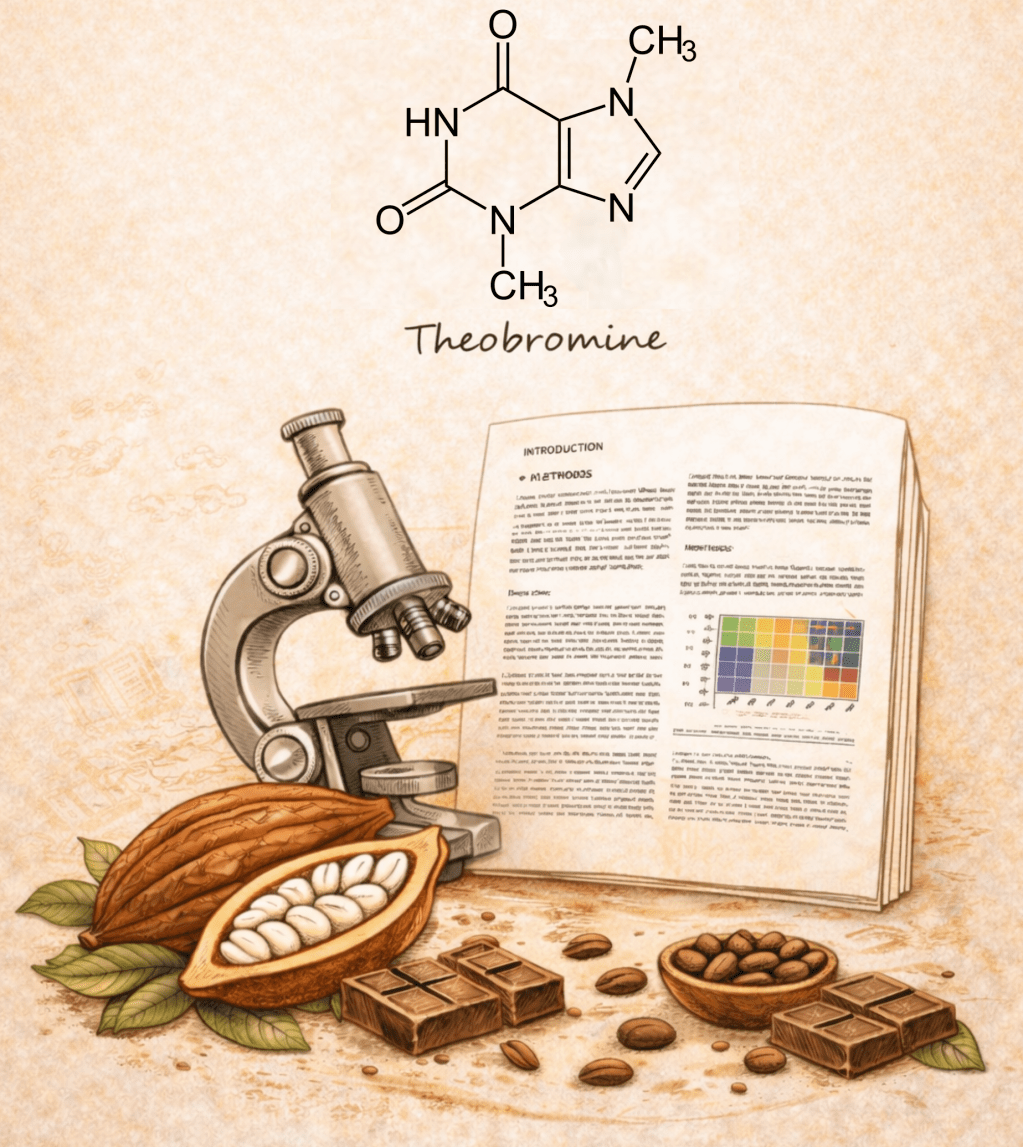
One of the often recognised ‘off-flavours’ in cacao is a smoke-like flavour. It’s something I’ve heard people talk about frequently (as some people like it, though most consider it a defect); therefore, I thought this paper would be a great first pick for the first “the science of chocolate” post.
What motivated the authors
A lot of progress has been made to identify the odorants (smell molecules) responsible for the flavours in cacao. There have been 20-30 good (pleasant) ones identified, but there are also bad (unpleasant) odorants found. The authors wanted to look for the source of some of these off-flavour odorants.
What they did
First, they created a worst-case reference sample by exposing cocoa to intense beechwood smoke, so they could confidently identify which aroma compounds truly smell smoky and shouldn’t be overlooked. They also got two cacao samples provided by Rausch, one from Indonesia and one from Papua New Guinea, that were both rejected due to the smoky off-flavor.
They then used gas chromatography–olfactometry (GC–O) and aroma extract dilution analysis (AEDA) to link specific molecules to the smoky smell. It’s tricky to explain, but here’s my attempt:
With GC–O , a machine separates the cocoa aroma mix into individual components/parts, and as they come out the machine one by one, for every one a smell can be identified (smoky, fruity, floral, etc.).
With AEDA, that same compound is diluted again, and again, to find which smells are the “strongest”. The compounds that are still noticeable when they are very diluted are likely the ones that matter the most to what we actually smell.
Finally, they compared the husk versus nib, to see where in the bean these smoke-derived compounds end up. This way, they could also determine whether removing the shell (husk) could reduce the smoky defect.
What they found
It’s impossible not to mention some of the compounds, but I’ll try and minimalise the chemistry.
First, the authors used the “worst-case smoked cocoa” to map out which specific smell molecules are responsible for a smoky taint when cocoa is exposed to wood smoke. Using GC–O and AEDA, they confirmed the same “smoke” odorants that earlier cocoa studies had already linked to smoky off-flavours. They used odour activity values (OAVs) to estimate which odours matter most for what people actually smell. The biggest contributors were 2-methoxyphenol, 4-methylphenol, and 3-ethylphenol. A key practical point that the authors make, is that the smoky compounds were not only found in the husk, but they had diffused into the nibs. Meaning winnowing (removing the husk) can’t reliably remove all of the defects once they’re there.
Next, they wanted to know “Does this matter at real-life levels?” They measured these smoky compounds and calculated the odour activity values (OAVs) of clean reference cocoa, the experimentally smoked cocoa, and two cocoa batches with confirmed smoke contact during drying at origin, to estimate which compounds are most likely driving what people actually smell. The smoked cocoa had clearly higher levels than the reference. The husk showed much higher concentrations than the nib, which makes sense because the smoke first contacts the outside of the bean. However, the authentic smoke-contact samples showed that, though the difference between husk and nib was much smaller, most of the smoky compounds were already in the nibs. In other words, by the time the cocoa reaches a chocolate maker, the smoky “defect” has often moved into the part where they actually make chocolate with. So even very good winnowing (shell removal) won’t reliably remove it.
They also discuss 2,6-dimethoxyphenol as potentially useful as a marker of smoke contact, even if it may not be the main smell driver, it can be used in chemical analyses to check for smoke exposure.
Summary
Using a combination of sensory-guided analytical chemistry methods to connect “what we smell” to “which molecules are responsible”, the authors show that wood smoke exposure can directly cause the “smoky” off-flavour in fermented cocoa. They link that defect to a small set of specific “smell molecules.” By comparing husk versus nib, they found these smoky compounds don’t just sit in the shell, but they diffuse into the nibs, meaning that removing the husk later (by winnowing) cannot reliably remove the smoky defect.
Paper details
Full title: Molecular Sensory Analysis Confirms Wood Smoke Exposure as a Source of Smoky Off-Flavors in Fermented Cocoa
Authors: Franziska Krause and Martin Steinhaus
Journal: Journal of Agricultural and Food Chemistry
Official citation: Krause F, Steinhaus M. Molecular Sensory Analysis Confirms Wood Smoke Exposure as a Source of Smoky Off-Flavors in Fermented Cocoa. J Agric Food Chem. 2025 Aug 6;73(31):19663-19669. doi: 10.1021/acs.jafc.5c06046. Epub 2025 Jul 25. PMID: 40713024; PMCID: PMC12333360.
Link to full article : https://pubs.acs.org/doi/10.1021/acs.jafc.5c06046
 By Diënty
Leave a comment