
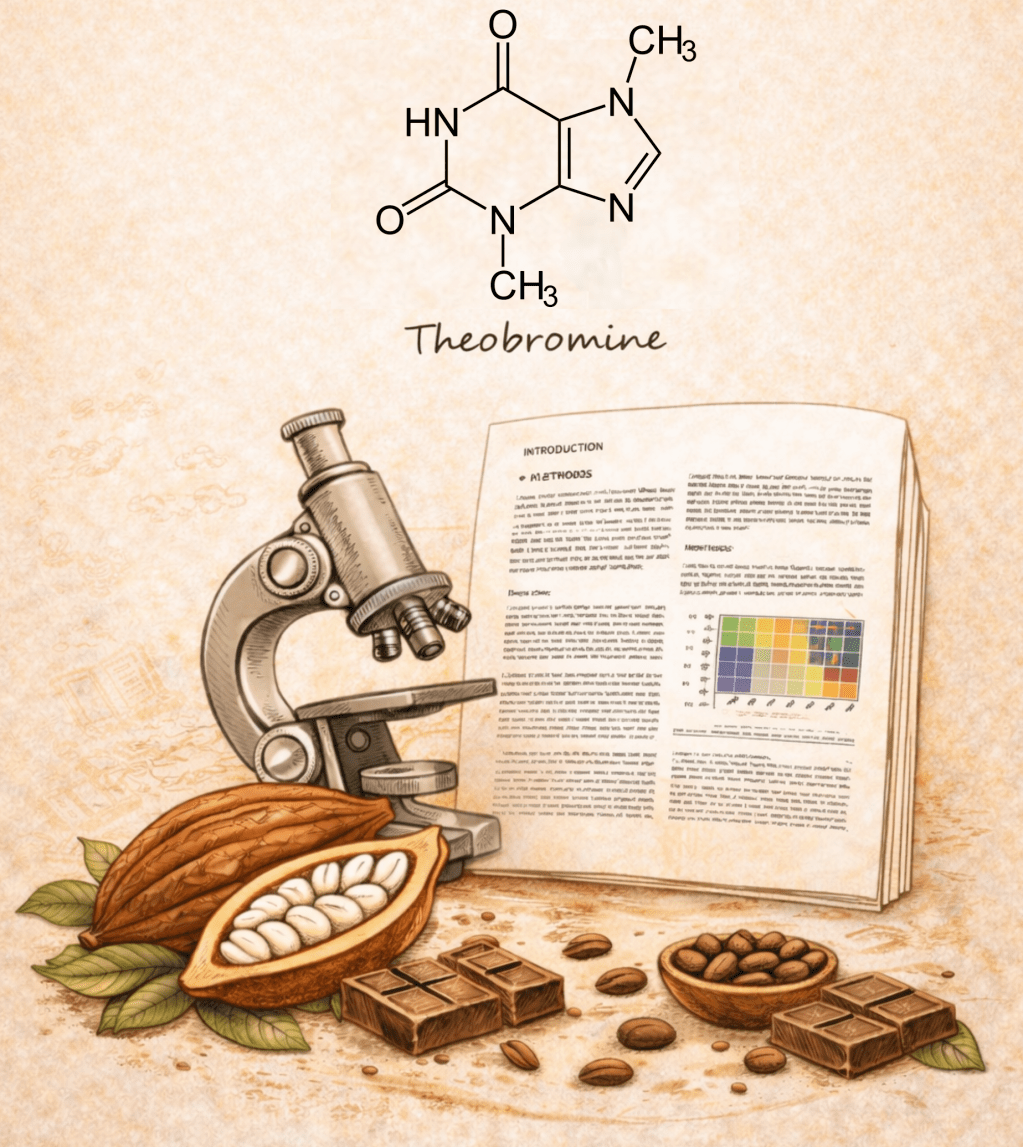
Working at a molocular laboratory, I thought it would be interesting to look at the genetics of cacao. I started looking and found this cool paper that looks at cacao growing in a country most people won’t directly associate with cacao: India, specifically in the unusual region of Terai.
In this paper they compare several cocoa clones with each other, and ask which ones give the most promising quality beans after processing, looking at a lot of things that would be good to review when determining what genetic variety to eventually plant to get the best product (high volume and good quality).
What motivated the authors
Cocoa quality depends on many factors (origin, climate, processing), and the authors of this papar argue that when you select a clone to use for produce, you need more than good planting material with a good yield. When looking at which clones to use, they say one should also include the overall quality and biochemical traits (fat, acidity, sugars, polyphenols/antioxidants, etc.). In India’s Terai region in West Bengal, some Indian cocoa clones have been grown for years, but their quality performance there has not been evaluated in detail, which is exactly what the authors of this paper did.
What they did
The authors harvested ripe pods from seven Indian cocoa clones (VTLCH 2, VTLC 5, VTLC 8, VTLC 11, VTLC 19 A, VTLC 61, and VTLC 66) grown in the Terai region. All pods were processed under the same controlled conditions using a randomised experimental set-up (each batch assigned by chance to prevent bias). The cacao pods were stored for 3 days, then beans were fermented for 7 days with scheduled turning; fermentation temperature was controlled in an oven (around 40°C–42°C). After fermentation, beans were washed and dried on a tray dryer, until shells could be removed.
They assessed fermentation quality using a cut test and fermentation index, and then measured multiple quality parameters in dried beans/nibs (pH, titratable acetic acid, free fatty acids, sugars, fat/protein/carbohydrates, anthocyanins, total polyphenols, and antioxidant capacity), comparing the clones statistically to one another.
What they found
All clones reached an “adequate fermentation level” afte day 7, based on cut test, but performance still differed between the clones. The fermentation index (most important parameter for this) of most clones were ≥1, which means well-fermented. Clone VTLC 5 had the highest ferentation index (1.73). Clone VTLC 61 had a fermentationindex of 0.96, which the authors link to the presence of germinated beans.
The pH was betwee 5.66 and 6.01 for all clones, showing no significant differences.
Free fatty acids varied a lot, from clone VTLC 61 with 3.74 mg KOH/g up to 14.58 mg KOH/g. The reducing sugars showed some differces too; VTLC 8 had the highest reducing sugar (5.57%). Please feel free to look at the paper for more details on these numbers.
In their final interpretation, the authors say that although clone VTLC 66 and VTLC 61 had high fat andcarbohydrates, their higher levels of germinated and slaty beans made them less suitable for high-quality processing. In the overall conclusion, clone VTLC 5 came out as the most consistent “best bet” to be used for cultivation and processing in the region of Terai. Combining good quality with an earlier yield performance.
Summary
This study compared seven Indian cocoa clones, grown in the Terai region. All clones were processed following the same controlled fermentation and drying conditions. Even with the same processing, the clones showed clear differences in fermentation performance and other key quality traits like acidity, free fatty acids, sugars, and bioactive compounds. The authors conclude that clone VTLC 5 offers the best overall balance for commercial cultivation and processing when considering growing cacao in the Terai region.
The authors furter argue that regional clone selection should always consider the biochemical quality parameters, as a common practice, and not just trades as yield, fat, and appearance.
Paper details
Full title: Evaluation of seven Theobroma cacao clones grown in Terai region of India for nutritional composition and bioactive compounds.
Authors: Koyelika Deb, Shrilekha Das, P. S. Medda, A. K. Sit & S. Elain Apshara
Journal: Scientific reports
Official citation: Deb, K., Das, S., Medda, P.S. et al. Evaluation of seven Theobroma cacao clones grown in Terai region of India for nutritional composition and bioactive compounds. Sci Rep 15, 35949 (2025). https://doi.org/10.1038/s41598-025-02406-z
Link to full article: https://www.nature.com/articles/s41598-025-02406-z
 By Diënty
Leave a comment