
To the people around me, I often talk about chocolate and don’t hesitate to explain why I call the stuff you buy in the supermarket ‘candy’. This led to a colleague of mine asking if I’d be interested in organising a chocolate tasting. A full evening, including food. I tried to rise to the challenge and said yes!
Where to start?
As a chocolate enthusiast, trying to educate the people around me on the amazing fine and craft chocolate the world has to offer, I could not say no to this opportunity. Thus after weeks of preparations, thinking about how to set up the evening, what chocolates to have people taste and what bars to compare, I’ll share with you some things I kept in mind while setting this up.
Who’s joining?
In my case, I realised the people who bought a ticket for this event, were not all people who loved chocolate. I was asked to organise one of a series of culinary evenings. Sessions before mine were themed around whiskey, wine and other fine foods. I imagined some would like to try some good chocolate, which to them could mean something like Lindt. But some of the people could also be dragged along by their partners, not beeing found of chocolate at all, or only enjoying the heavily burned bars with high percentages of cacao. All in all: a mixed crowd ready to be dazzled.
What do I want people to remember?
For this, I reflected on my own experiences. Why did I switch from bulk to fine chocolate? Of course, one has to like what one eats, but that was not what captivated me. I recall very vividly, at my first craft chocolate encounter in the Tropenmuseum, that I could tell the differences. I’ve tried several bars and all of them brought me new flavours. Without any training or refind profilling, tasting notes were obviously different between bars.
Pairing the chocolates
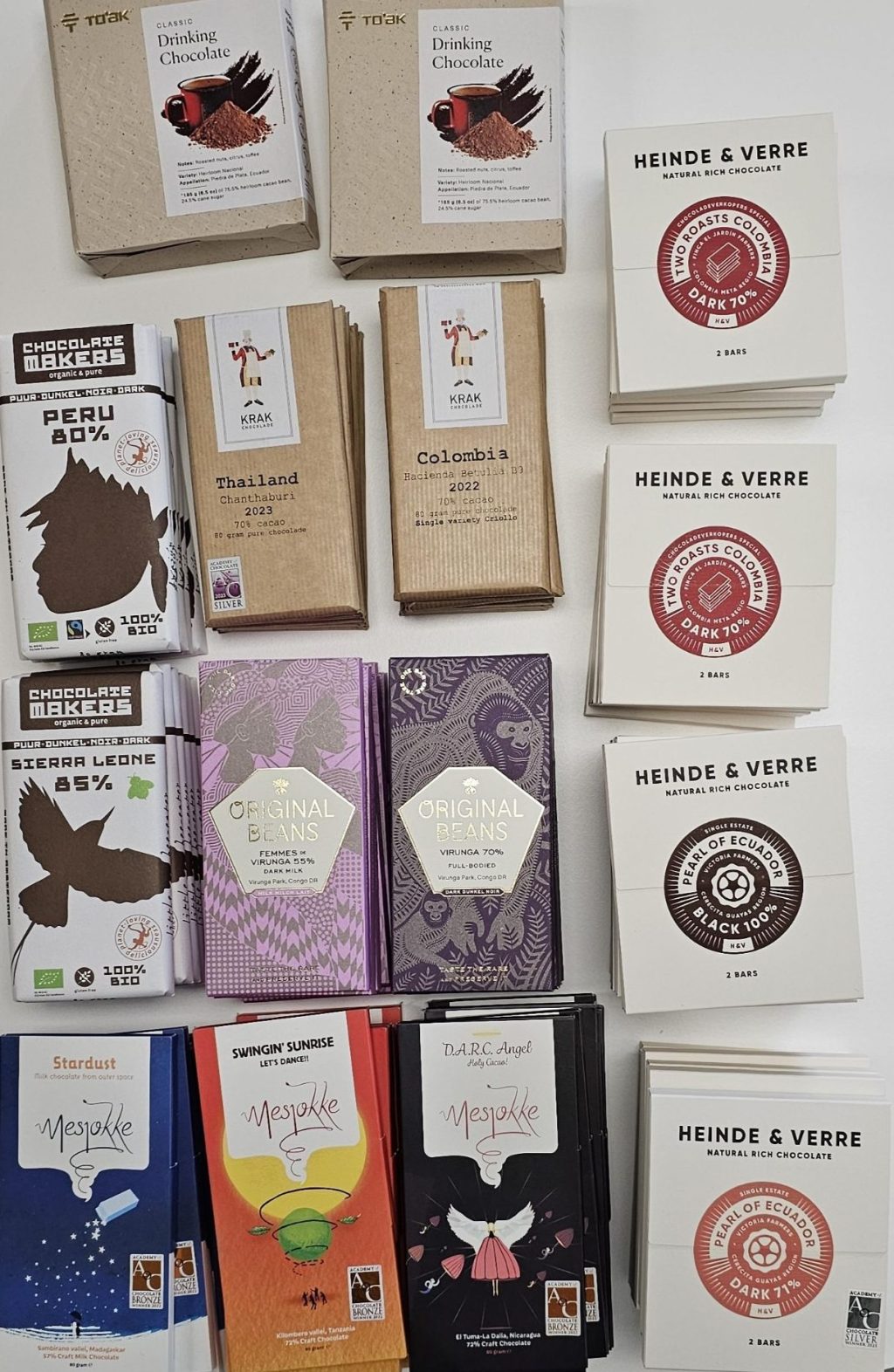
Keeping the above in mind, I wanted to show my crowd of tasters that the world of chocolate is as deep in flavour (if not deeper) than the fine wines they had on previous occasions. After some brainstorming, I came up with the list below. Looking at it (after making it), I have to admit that I was definitely biased towards Dutch chocolatemakers. Probably because that was what I knew best and tried the most. As to the amount to order, I calculated 5 grams per bar per person (in this case, a total of 65 grams per person).
Chocolate bars
Original Beans Femmes de Virunga
Original Beans Cru Virunga
Heinde & Verre Two roasts Colombia
Heinde & Verre Two roasts Colombia
Krak Thailand Chanthaburi
Krak Colombia Criollo Betulia B9
Mesjokke Swingin’ Sunrise Tanzania
Mesjokke Stardust Madagaskar
Mesjokke DARC Angel Nicaragua
Heinde & Verre Pearl of Ecuador
Heinde & Verre Pearl of Ecuador
Chocolatemakers Awajún
Chocolatemakers Sierra Leone
When you look at this list, (I hope) a few things stand out:
First: I always had (at least) 2 bars by the same maker. To show that the difference in taste does not relate directly or fully to the chocolate maker.
Second: I selected both milk and dark chocolate bars. Hoping to show that; though sweeter than dark, milk chocolate is not sweet and can have a high complexity and depth of flavours.
Third: The same bean/bar with a different percentage. Sugar matters in how you experience chocolate and offering a 70% and a 100% variaty made with the same beans seemed like a good way to have people experience this first hand.
Fourth: The fifferences between origins and genetics. By adding the Krak bar made with Colombia Criollo Betulia B9, people can see that the colour of a bar tells quite a different story than they expected.
Fifth: Beautifully timed Heinde & Verre released a special two-roast bar. 1 pack with two chocolate bars made from the same batch of cocoa beans. One bar made with beans with a short roast at a high temperature, and one bar where the beans had a longer roast at a lower temperature. Perfect to let people experience what the difference in roasting can do.
I am not a refined wine or Scotch drinker, but I was asked if I could include a pairing of a drink with a chocolate. As I was given a lot of freedom on how to set it all up, I used it. We all know (though sometimes forget) that we consume chocolate in many ways. Especially because I expected a gourmet loving crowd, I really wanted to introduce them to another form of chocolate that I love: bonbons. And not just any: Caramboles! Rita had released a wonderful box of whiskey chocolates that were perfect for the occasion, so I reached out to her and included two mind-blowing bonbons to the evening’s tasting session:
Bonbons by Carambole
14. Smoky whisky, dark salty caramel, Piedmont hazelnut, Piedmont praline, The Chocolate Tree
15. Whisky, sea buckthorn, honey, Tahitian vanilla, olive oil, chocolate – Krak Hojicha (white chocolate with roasted green tea)
A bit too much (in hindsight) and at the evening itself, I decided to skip this one, but I also ordered a drinking chocolate to add to the multilayer experience:
Drinking chocolate
To’ak
I loved organising this session, pairing the chocolates and will soon tell you how I filled the evening program. As for what I learned setting up this event: 13 bars is too many (even for a full evening). Next time I’d stick to a maximum of 8 bars. I do love the addition of the bonbons, as they are a whole different ballgame.
 By Diënty
Leave a comment