
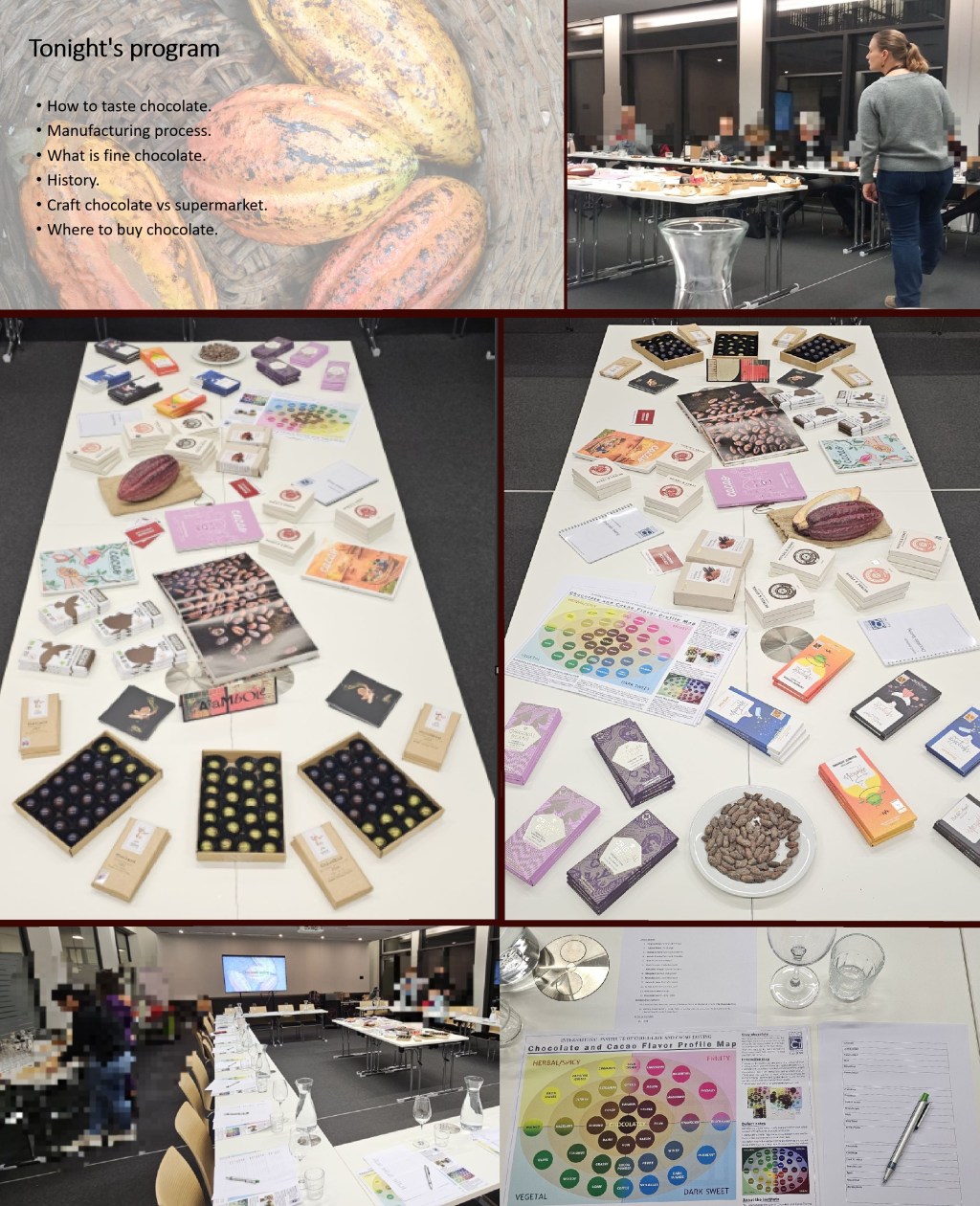
Following up on my chocolate selection, comes the next step: setting up the program.
What an exciting journey this was! I was given a 3-hour timeframe with a break that provided savory food. A strong emphasis on “There should be enough chocolate”. I thought about it a lot and came up with an interactive talk(or rather listen) and taste program.
In short, I started with an introduction of myself (and why I stood before people), followed by explaining how one should taste (not eat) chocolate. Then we tasted two different bars. I explained the manufacturing process, after which we again tasted two bars. I explained what I consider fine/craft chocolate, and we again tasted two bars this time followed by a break of savoury foods. You get the gist, right? Depending on what I would talk about, I would try to match the subject with an appropriate bar or two.
We tasted a total of 13 different bars, while I further talked about history, craft VS bulk chocolate, and where you buy your chocolate (and what to keep in mind when buying).
It was a very interesting and interactive session that I supported with a visual presentation, only using pictures I made myself on my cacao journey.
With all that talking, what did I talk about? Let me break it down a bit in sections:
How to taste chocolate?
As I was instructed and taught to taste chocolate, I explained to the group joining me on this tasting journey, how one should eat chocolate: you look, touch, listen, smell, bite, and let it melt. For the first chocolate we taste, I do this with them step by step the first time, and after that, I try to feel the room. Some people were really into it, making notes the whole time, while others seemed less into the process. I showed people the profiles the makers gave the chocolate, but also what I tasted, indicating there is no wrong in what you taste. The most important thing to determine, is if you like the chocolate, yes or no?
Manufacturing process
Using different pictures and a more technical flow chart, I’ve tried to explain the process. Starting at the farm, with the trees and the flowers. Going from harvesting the pods, to fermentation and drying, all the way to the chocolate maker, roasting and refining. Especially for this latter part, I have quite a rich picture deck of equipment that I have used to clarify the process. I displayed these together with the cacao to chocolate transformation. And what better ending than to taste two chocolates made from the same batch of cacao beans, but with a different roast….
What is fine chocolate?
I enjoyed breaking up the tasting with these little chats leading up to the next two or three bars to taste. One of the subjects I touched on is what is ‘ fine chocolate ‘? I’ve tried to highlight chocolate as a luxury product with deep flavours, terroir and nuance, rather than approaching it as a generic sweet. Highlighting the complexity, traceability and flavour expressions (tasting a complex, multi-layered chocolate afterwards, ofcourse). But also showcasing how bulk cacao is handled and comparing the ingredients of both.
History
A theme not to miss and a moment to get serious too, though not too tough. I made a timeline and explained the process that I suppose many people have done before me. However, I also found it to be an opportunity to showcase the increasing transparency and awareness of the people behind cacao production: the farmers and local traders. In my case, I used the next bars we would taste and mentioned the bean price paid to farmers by the chocolate makers. So not just the historical angle, but also how our understanding of quality, origin, and fairness has evolved.
Craft chocolate vs mass market
The difference between craft and mass market chocolate can be difficult to both grasp and recognise. Packaging is misleading, and terms such as “fine chocolate”, “single origin” and “bean to bar” are not patented, and thus used by everyone. Therefore, I spend some time breaking down some basic rules on what the difference is (in production, ingredients, wages) and how people can recognise the difference for themselves.
Where to buy chocolate?
One of the last points, but an important one: I tell people where and how I get my chocolate, and how they can get some, if they are looking for it. I have a speciality store in the place I live, and I send everyone there. But next to that, I also share two webshops that I absolutely adore. It’s a help, but I also (still) get asked to bring people chocolate…
I loved organising and putting together this (rather long) tasting session. Starting with pairing the chocolates, building an evening filling program around it. My audience was very diverse, and I had not anticipated how encaged people would be. I truly got a lot of questions, not just about the chocolates, but about what I showed and explained as well.
As for what I learned from setting up this event: 13 bars to taste is too many (even for a full evening). Next time (already planned), I’ll stick to a maximum of 8 bars. I did enjoy the break from the tastings, and people had a lot of questions, making it a very interactive event. What do you think? Does it sound like a tasting you’d join?
 By Diënty
Leave a comment