
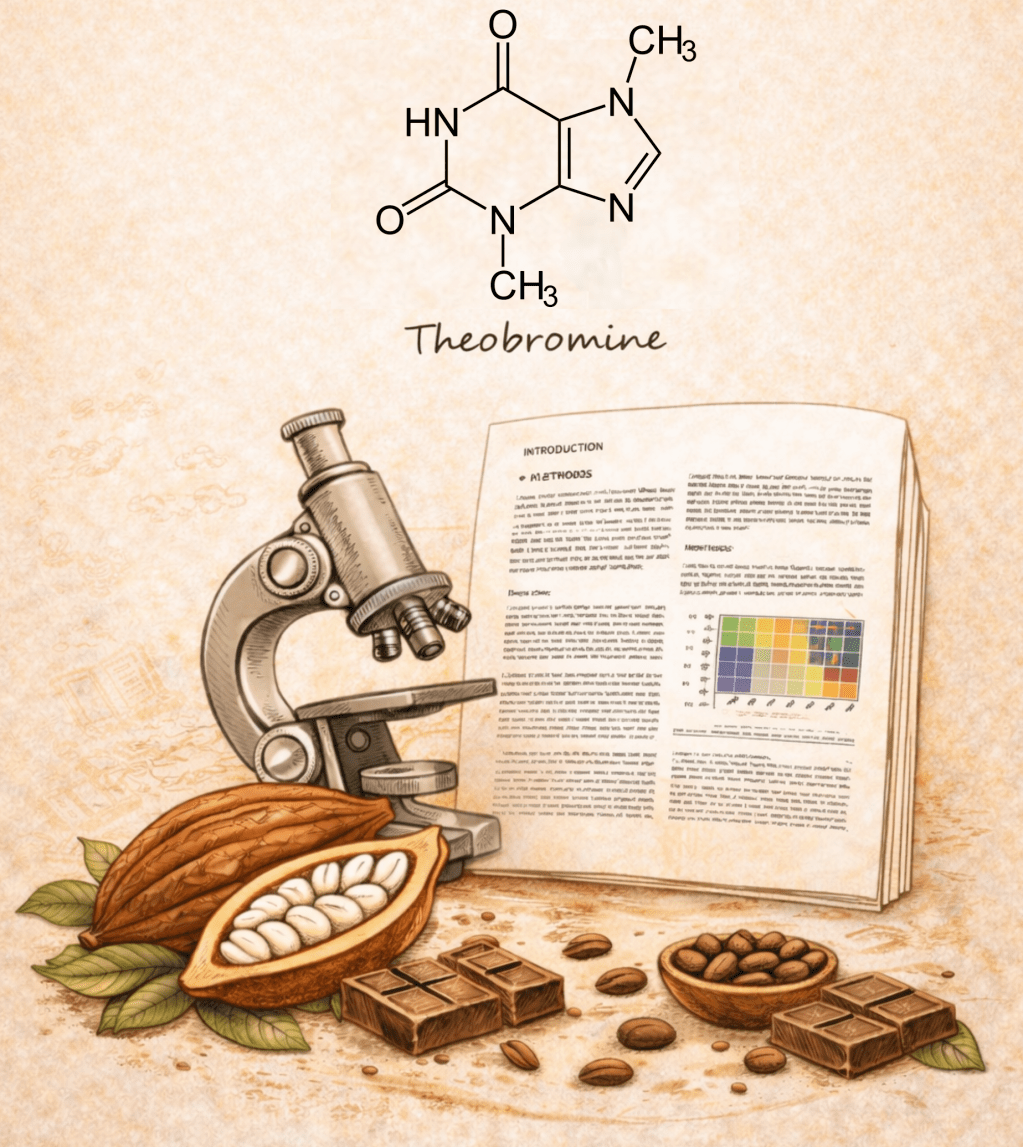
Chocolate aroma (volotiles) is shaped by so many different things: the terroir, genetics, fermentation and roasting are only a few things that shape the flavour profile of the chocolate we eat. What happens later, either in the factory or on smaller scales in homes, especially the steps of refining and conching, noticeably change the so called volatile compounds (the molecules that evaporate and reach your nose). The authors of this paper look at exactly that: how the volatile profile changes from cocoa liquor, to flakes after refining, to the finished chocolate after conching.
What motivated the authors
The authors explain in detail how conching influences the flavour development, and that the “chocolate volatilome” (the full mix of volatile molecules) depends on many different things: origin, variety, harvest season, and post-harvest processing. They hilight that manufacturing steps like conching are an important contributing step that has a high impacton the final chocolatetaste.
While we know conching affects flavour, there’s still a lot to learn about which aroma-active compounds change during the production process, and how the overall volatile (aroma) profile shifts from one processing step to the next. Their goal was to track these changes through refining and conching, sampling in between, to better understand how the chocolate aroma development takes place during manufacturing.
What they did
The authors got cocoa liquor from Ivory Coast/Ghana, sugar, and deodorized cocoa butter. They used this to produce a standard dark chocolate. During this process, they sampled the chocolate at three different processing stages: cocoa liquor, the product after refining (flakes), and after conching (final chocolate). To analise and compare the volotile organic compounds (VOC) of these stages, they used two complementary approaches and compared the outcomes. They did further aroma analysis and principal component analysis (PCA)
To get a ‘smell fingreprint’, which can be used to compare the profiles of volatile organic compounds (short VOCs), they used GC–IMS. What’s that? First, GC (gas chromatography) is a technology that separates the mix of smell molecules into individual parts. Then IMS (ion mobility spectrometry) is used to sort those molecules based on how they move through a gas when they’re electrically charged. The result is a fast way to compare and spot differences in a sample’s overall aroma/volatile profile.
To find the aroma-active volotile molecules (the ones that actually smell like something to us humans), they used GC–MS/olfactometry combined with AEDA. Let’sbreak that one down too. Again the GC (gas chromatography) separates the complex mix into individual compounds. The following MS (mass spectrometry) helps identify each of those individual compounds (what they are). Olfactometry is a notation of what these compounds smell like. AEDA (aroma extract dilution analysis) is the repeated diluting of the aroma extract, step by step, to see which smells are still detectable when they are very diluted.
What they found
They identified 63 aroma-active regions using AEDA. 58 of those regions were detected in cocoa liquor, 45 in flakes, and 35 in chocolate. There were even new ones identified. The authors state that refining doesn’t just “tone down” the aroma, but it can also shift the volatile profile. After refining, some VOC signals increased, and these changes helped clearly distinguish refined flakes from cocoa liquor when the authors compared overall volatile fingerprints. In other words, refining can make certain compounds more prominent and already contributes to stage-to-stage aroma differences, even before conching starts.
In general, the number of detected compounds found and the “strength ranking” (Flavor Dilution factors) decreased as the chocolate processing progressed. This means the aroma profiles become less complex in some ways, meaning with longer conching, less aroma completely was found. If you are interested and have the time, I suggest you have a look at table 1 of the original paper, where the authors show a comparitative overview of the chemical odorant and odorant quality (the compound and what it smells like) for each of the three sample moments.
However, not everything simply drops: aldehydes partly increased across steps, which the authors link (among other things) to lipid oxidation. And while VOC intensities mostly decreased after conching, some individual VOCs increased after refining and/or conching and helped distinguish the samples taken at each stage. The authors also note that a substantial portion of the VOCs detected may not be aroma-active. In other words, not every volatile compound is necessarily contributing to what we smell.
Summary
Still with me? This paper shows that refining and conching don’t just change texture. They measurably reshape the volatile profile of the chocolate. In general, conching is linked to a drop in VOC intensities and a decrease in the number/strength of many aroma signals, while some aldehydes increase. The broader takeaway of this is that “chocolate flavour development” continues well beyond roasting. During both refining and conching, VOCs continue to change, allowing makers to influence which aromatic signature they want the chocolate do develop. Tracking of volatiles across manufacturing steps, could be seen as a useful way to monitor and control chocolate aroma development.
Paper details
Full title: Refining and conching alter the volatile composition of dark chocolate — Revealing profile changes in aroma-active volatiles and volatile organic compounds
Authors: Yvonne Guckenbiehl , Eva Ortner , Isabell Rothkopf & Andrea Buettner
Journal: Journal of Agriculture and Food Research
Official citation: Deb, K., Das, S., Medda, P.S. et al. Evaluation of seven Theobroma cacao clones grown in Terai region of India for nutritional composition and bioactive compounds. Sci Rep 15, 35949 (2025).
Link to full article: https://doi.org/10.1016/j.jafr.2025.101664
 By Diënty
Leave a comment