
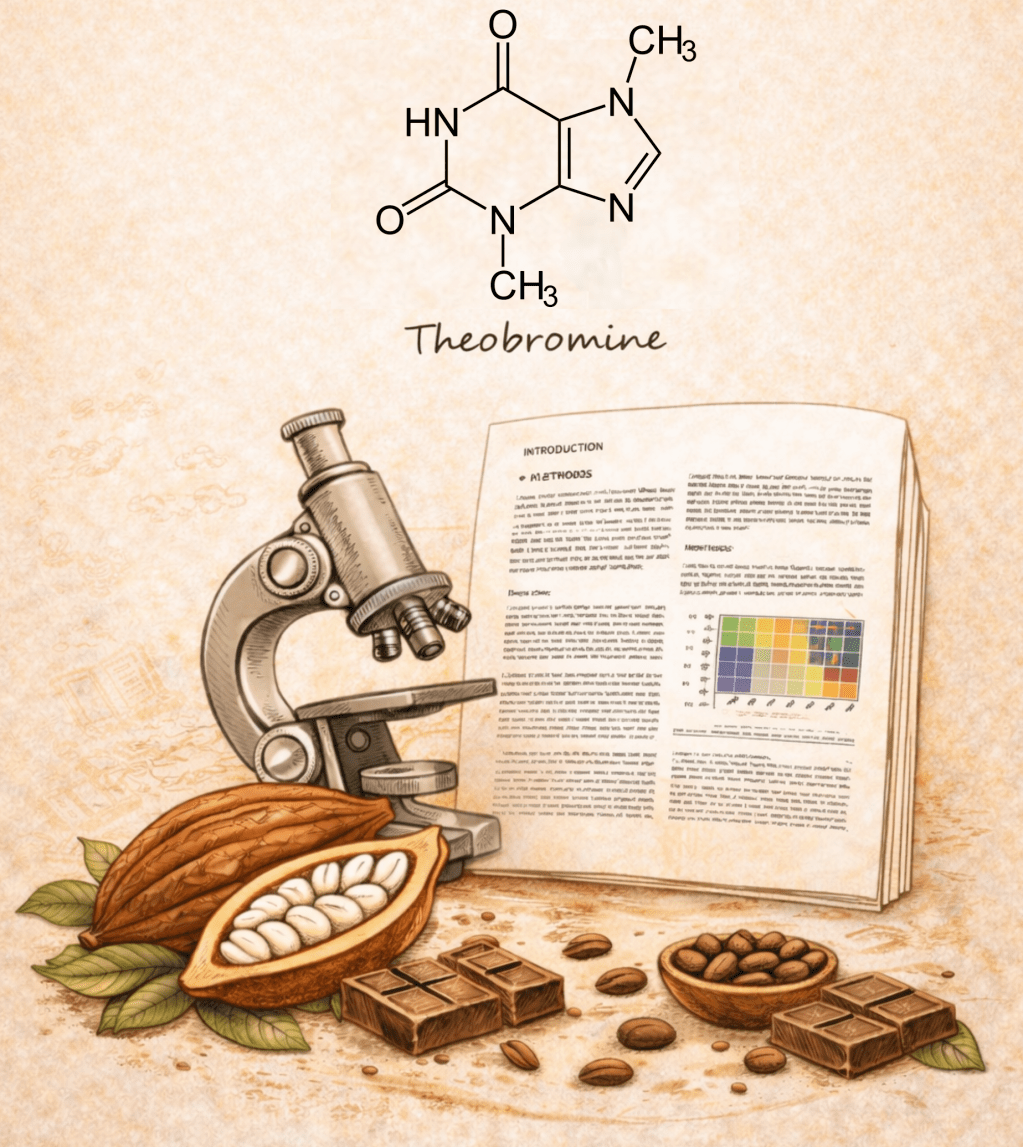
As a microbiologist by training, I have always found microbes interesting. Currently I work with bacterial strains and communities, but unfortunateley not in the realm of cacao. hence it is high time for some microbiology on the science of chocolate.
Cocoabean fermentation is most often left to chance; a spontaneous fermentation. Farmers pile beans into wooden boxes, baskets or heaps, cover them and let microbes that happen to be present in the enviroment (on the pods, in the boxes, in the air) do the fermentation work. That unpredictability is a big part of the reason why fermentation outcomes (and the resulting chocolate flavour) vary so much from farm to farm.
What actually happens during fermentation (a little background first)
Before getting into the paper itself, let’s take a minute to explain what “fermentation” actually means here, since it’s doing a lot of work in this post. Freshly cracked-open cacao pods don’t taste anything like chocolate. The beans are covered in a whitish, sweet pulp, and on their own they’re bitter and flat, with none of the flavour we associate with chocolate. Fermentation is the step that changes that: beans and pulp are piled together for several days, and the sugars in the pulp are broken down by living microbes: bacteria and yeasts. This process produces heat, acids and a whole range of new flavour-precursor compounds as a byproduct. Those precursors don’t taste like chocolate yet either, but they’re what later gets transformed into chocolate flavour during the roasting process.
The key detail for this specific paper is which microbes do that job, and how they get there. Unlike wine, beer or cheese, where a specific starter culture is deliberately chosen and added to help the fermentation, in cacao fermentation is almost always a “spontaneous” process. Whatever bacteria and yeasts happen to be living on the beans, on the farm equipment, or in the surrounding air, settle down and start the fermentation process. That combination of bacteria and yeasts is what we call a “microbial community”. So not one microbe doing the work, but a group of many different species, each contributing in different stages of the process with their own signature. It’s also exactly why fermentation outcomes (and the resulting chocolate flavour) are so unpredictable from farm to farm. Nobody is really in control of which bacteria and yeasts show up to do the fermenting.
What motivated the authors
Good fermented cocoa beans can develop complex, desirable flavour notes and poorly fermented beans tend to be bitter and astringent. But because the fermentation process is commonly spontaneous, the outcome depends on exactly which microbes colonise (are present on) the beans and how conditions like temperature and pH develop over time, as the fermentation proceeds. This complex relationship involves a lot of different things and is not well understood.
The researchers who wrote this paper wanted to identify which things actually drive the “fine flavour” development of the beans, and then they aimed to test something more ambitious: whether that understanding can be used to design a defined, reproducible microbial ‘starter’. A phenomenon that the wine, beer and cheese industries already rely on.
What they did
The team worked with fermenting cocoa beans from three commercial farms in Colombia (Santander, Huila and Antioquia), that they sampled across multiple harvests. They followed the following steps:
1) They tracked temperature and pH throughout the fermentation, measuring at different depths in the fermentation box and separately in the sticky bean pulp/testa and the cotyledon (the part of the bean that actually becomes chocolate). In a way they took the fermentation’s vital signs every few hours for over about a week.
2) Used ‘shotgun metagenomic sequencing’ to follow how the bacterial and fungal communities changed over the course of fermentation. Rather than trying to grow and identify each microbe one at a time in a lab dish (which only works for the ones that are easy to culture), this method reads all the DNA (genetic material) present in a sample at once, so it captures the full community/group, including species that are hard or impossible to grow.
3) They produced cocoa liquors from the fermented beans, then had a trained sensory panel compare them against known bulk and fine-flavour reference chocolates, including references from Madagascar, Ivory Coast and Ghana.
4) Next they used the DNA data to computationally reconstruct 55 individual microbial genomes (called MAGs, short for metagenome-assembled genomes) out of the mixed community, then built models of what each of those microbes could metabolically produce, in order to work out which specific microbial functions were actually needed to generate the compounds behind the fine flavours we value in chocolate, as a final product.
5) Used the information above, they hand-picked a much smaller, defined set of just 9 bacterial and fungal strains that could be grown individually in the lab. A synthetic community. These 9 were chosen to cover the same taxonomic and metabolic ground as the full natural community they found earlier, but in a form that could actually be reproduced as a starter culture.
6) They fermented fresh cocoa beans under controlled conditions using this synthetic community of 9 microbes, as a starter. They compared them against beans left uninoculated, beans given a randomly assembled set of microbes, and so called “dropout” versions of the synthetic community missing one of the strains at a time (a common trick for testing whether every member of a community is actually necessary, or whether some are redundant). They then measured the flavour-related chemical compounds in the resulting liquors and had the same trained tasting panel score them, to see how closely the lab-made fermentation with the synthetic community matched the real thing.
What they found
The fermentation process followed a consistent pattern across all the farms: Can’t avoid some microbial family names here, though I won’t go into detail.
The temperature during fermentation rose in an S-shaped curve, increasing over time while pH decreased, and the microbial diversity (different microbes found) slowly became less. The bacteria changed from early colonisers (Erwiniaceae) to the acetic-acid bacteria (Acetobacteraceae, which were found to be the vinegar-makers), drifting into the fungi getting into Saccharomycetaceae species. These patterns predicted the following taste: Santander and Huila liquors resembled a fine-flavour Madagascar reference, while Antioquia’s resembled bulk references. Two yeasts in particular, Torulaspora and Saccharomyces, stood out as to be linked to fine-chocolate notes. Meaning if those are present during fermentation, fine flavours are more likeley to develop.
The even bigger finding, according to the authors, is that despite hundreds of species that are present in the natural community, many of them turned out to do overlapping jobs. This would suggest a smaller, specific hand-picked group of bacteria and fungi could do the same work and deliver the same flavour profile. The 9-strain synthetic community was used to prove this concept, reproducing the fine-flavour temperature/pH pattern and producing liquors the tasting panel scored as genuinely fine-flavoured. Random microbes, missing strains, or no inoculation at all all gave flatterflavout results. This shows that the specific combination of the 9 microbes was what mattered, not just “any microbes.”
A nice side-detail: bacteria on the fermentation box surfaces seem to act as a kind of “memory,” in a way they reliably seem to be reseeding each new batch of beans, while the fungi seem to arrive more from the wider environment.
Summary
This study shows that the cocoa fermentation progress, long treated as an uncontrollable black box, can be understood well enough to adjust and somewhat reverse-engineer the process. By linking specific temperature/pH patterns and microbial groups to fine-flavour outcomes, the researchers have shown they could build a defined 9-strain starter culture that reproduces the sensory hallmarks of the compared fine-flavour chocolate, under controlled conditions. Though it’s an early step, it seems to be a concrete step towards giving cocoa fermentation the kind of reproducibility that wine, beer and cheese production have had for a long time.
Paper details
Full title: A defined microbial community reproduces attributes of fine flavour chocolate fermentation.
Authors: David Gopaulchan, Christopher Moore, Naailah Ali, Darin Sukha, Sergio Leonardo Florez González, Fabio Esteban Herrera Rocha, Ni Yang, Mui Lim, Tristan P. Dew, Andrés Fernando González Barrios, Pathmanathan Umaharan, David E. Salt & Gabriel Castrillo.
Journal: Nature Microbiology
Official citation: Gopaulchan, D., Moore, C., Ali, N. et al. A defined microbial community reproduces attributes of fine flavour chocolate fermentation. Nat Microbiol 10, 2130–2152 (2025).
Link to full article: https://doi.org/10.1038/s41564-025-02077-6
 By Diënty
Leave a comment