
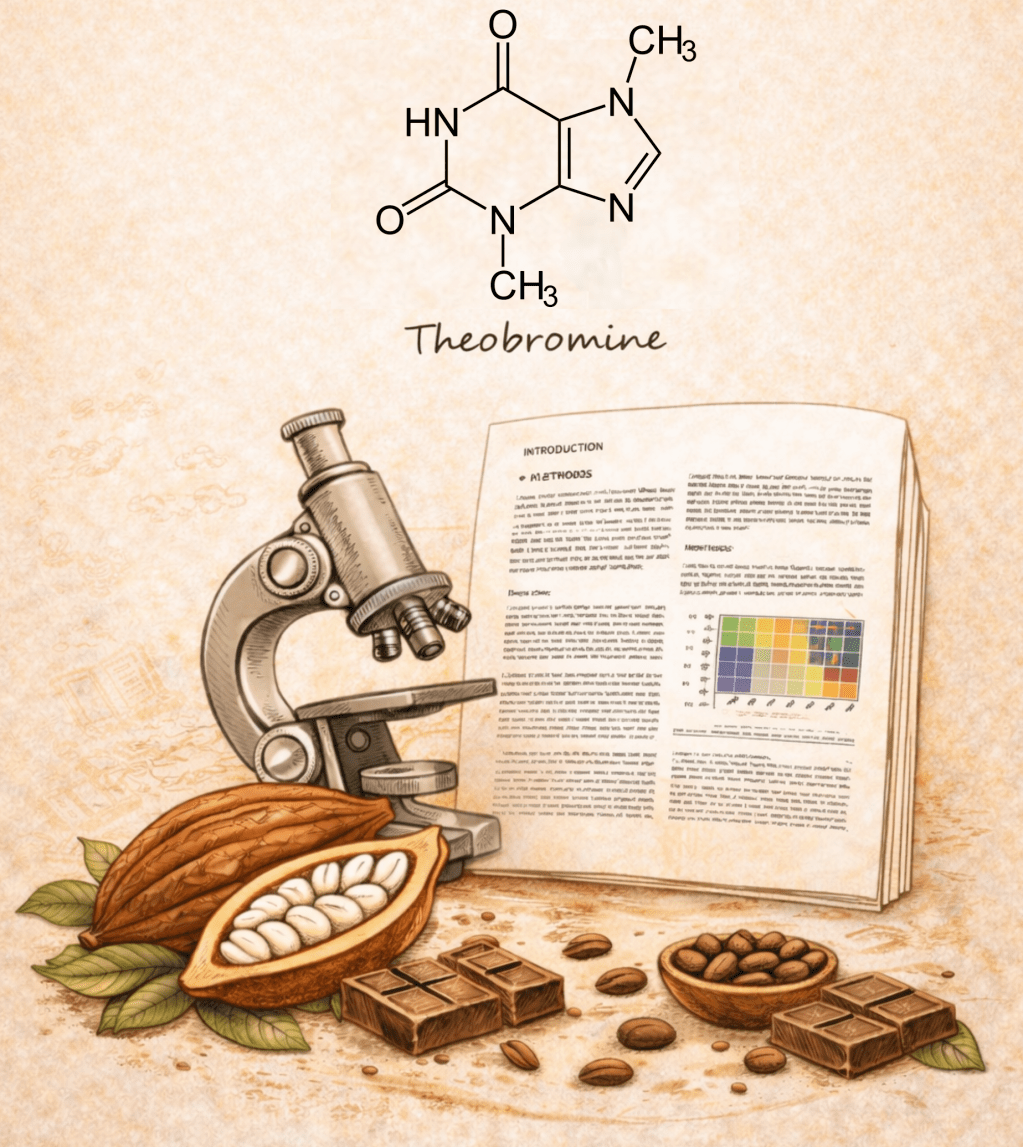
This time a study that did something with cocoa fermentation: rather than just observing which microbes show up naturally, the researchers actively bred a new yeast strain . They designed it to survive some of cocoa’s harsh fermentation conditions while pumping out far more fruity aroma compounds than the other yeasts that normally dominate do. Then they tested whether this different yeast actually changes the flavour of the final chocolate.
Esters, and fermentation heat as an obstacle (a little background first)
A lot of the fruity characters in fermented foods and drinks (chocolate, beer, wine) come down to a group of specific aroma compounds called esters. They are made by yeast as a byproduct during fermentation. Isoamyl acetate smells like banana, ethyl acetate is fruity and slightly solvent-like, and phenylethyl acetate leans toward rose and honey. Different yeast strains vary a lot in how much of these esters they produce, which is exactly why the ‘choice’ of yeast matters so much for the flavour development.
The catch is heat. Cocoa pulp fermentation isn’t gently warm like a lot of other fermentations. As the microbes get to work, the temperature climbs to around 45°C to 50°C. Most of the known strongly aromatic, ester-producing yeast strains, used in the wine and beer industries, simply don’t survive those temperatures; they die. So even when researchers have tried adding a nice aromatic yeast as a starter culture in the past, it tends to get quickly overwhelmed by the temperature and outcompeted by the tougher, heat-tolerant yeasts strains already living on the farm. The fermentation carries on more or less as if nothing was ever added in the first place. That’s the specific obstacle this paper set out to solve.
What motivated the authors
Despite several previous attempts, no one had managed to reliably use a starter culture to change cocoa’s flavour outcome in a reproducible way. The authors suspected this was precisely because the yeasts tested so far had to trade off one desirable trait for the other: aromatic strains couldn’t handle the heat, and heat-tolerant strains weren’t very aromatic. They wanted to find out whether a yeast could be developed that had both properties at once, and if so, whether that would actually be enough to shift the flavour of finished chocolate product.
What they did
The authors started with the “robust” Saccharomyces cerevisiae yeast strains already known to dominate cocoa pulp fermentation thanks to their heat tolerance. They separately took “aromatic” strains from the beer and wine industries known for high ester production. They then bred hybrids between the two groups, mixing pairs of yeast strains (the same basic principle as cross-breeding plants or animals), to combine traits from both parents in the offspring. They screened the resulting hybrids for ones that kept the heat tolerance of the robust parents while inheriting the aroma production of the aromatic ones. Alongside these hybrids, they also tested two wild, naturally very aromatic non-Saccharomyces yeast species as potential starters.
All these candidate strains, plus the original parent strains, were tested first in small lab-scale cocoa pulp fermentations first. Then they were used in real pilot-scale field trials in Malaysia, alongside untouched spontaneous fermentations as controls. The researchers tracked which yeasts actually dominated each fermentation using DNA fingerprinting (a technique that matches two samples by comparing unique patterns in specific regions of their DNA, rather than reading the whole genome).
They also measured the aroma compounds produced using gas chromatography-mass spectrometry (GC-MS, a technique for identifying and measuring individual aroma molecules in a sample). They then took the fermented beans and created chocolate, which a trained expert sensory panel tasted and scored.
What they found
The breeding worked: several hybrids combined significantly better heat tolerance than the aromatic parents with up to five times more ester production than the robust parents. In the field trials, these hybrids (and the robust parents) successfully dominated their fermentations, just as hoped. The two wild aromatic non-Saccharomyces yeasts, despite being highly aromatic on paper, told the opposite story: they couldn’t compete with the native microbes. They disappeared within the first day or two, and ended up having very little effect on the final flavour. A clean confirmation that thermotolerance really was the missing piece all along.
Interestingly, just using any dominant, controlled starter culture (rather than leaving fermentation to chance) reduced unpleasant “rancid” and “buttery” off-flavour compounds compared to the spontaneous fermentations. But not everything survived the journey to finished chocolate: after roasting and conching, several short, highly volatile fruity esters disappeared almost completely. Isoamyl acetate (banana-like) dropped by about 93%, ethyl acetate by about 66%, While longer, more fat-soluble esters like ethyl octanoate and ethyl decanoate came through largely unaffected.
Despite that loss, the sensory panel could still clearly tell the chocolates apart: chocolate made with one particular hybrid, H40, was rated distinctly fruitier than the others, while chocolates made with the heat-tolerant parent strains leaned more toward strong cocoa and roasted notes, and one other hybrid produced a noticeably sweeter chocolate.
Summar
This was one of the first studies to convincingly show that a deliberately chosen (or in this case, purposefully created) yeast starter culture can produce a measurably richer chocolate taste. From fermentation all the way through to the finished bar. In other words, the microbes involved in the fermentation process contribute and are essential to the final flavour profile. The biggest barrier to making this starter culture way of fermenting work reliably was never really about finding an aromatic-enough yeast, but about finding one tough enough to survive cocoa’s own fermentation heat.
Paper details
Full title: Tuning Chocolate Flavor through Development of Thermotolerant Saccharomyces cerevisiae Starter Cultures with Increased Acetate Ester Production
Authors: Esther Meersman, Jan Steensels, Nore Struyf, Tinneke Paulus, Veerle Saels, Melissa Mathawan, Leen Allegaert, Gino Vrancken & Kevin J. Verstrepen
Journal: Applied and Environmental Microbiology, Volume 82, No. 2, pages 732–746 (January 2016)
Official citation: Meersman, E., Steensels, J., Struyf, N., Paulus, T., Saels, V., Mathawan, M., Allegaert, L., Vrancken, G., and Verstrepen, K.J. 2016. “Tuning Chocolate Flavor through Development of Thermotolerant Saccharomyces cerevisiae Starter Cultures with Increased Acetate Ester Production.” Appl. Environ. Microbiol. 82(2): 732–746.
Link to full article: https://doi.org/10.1128/AEM.02556-15
 By Diënty
Leave a comment