
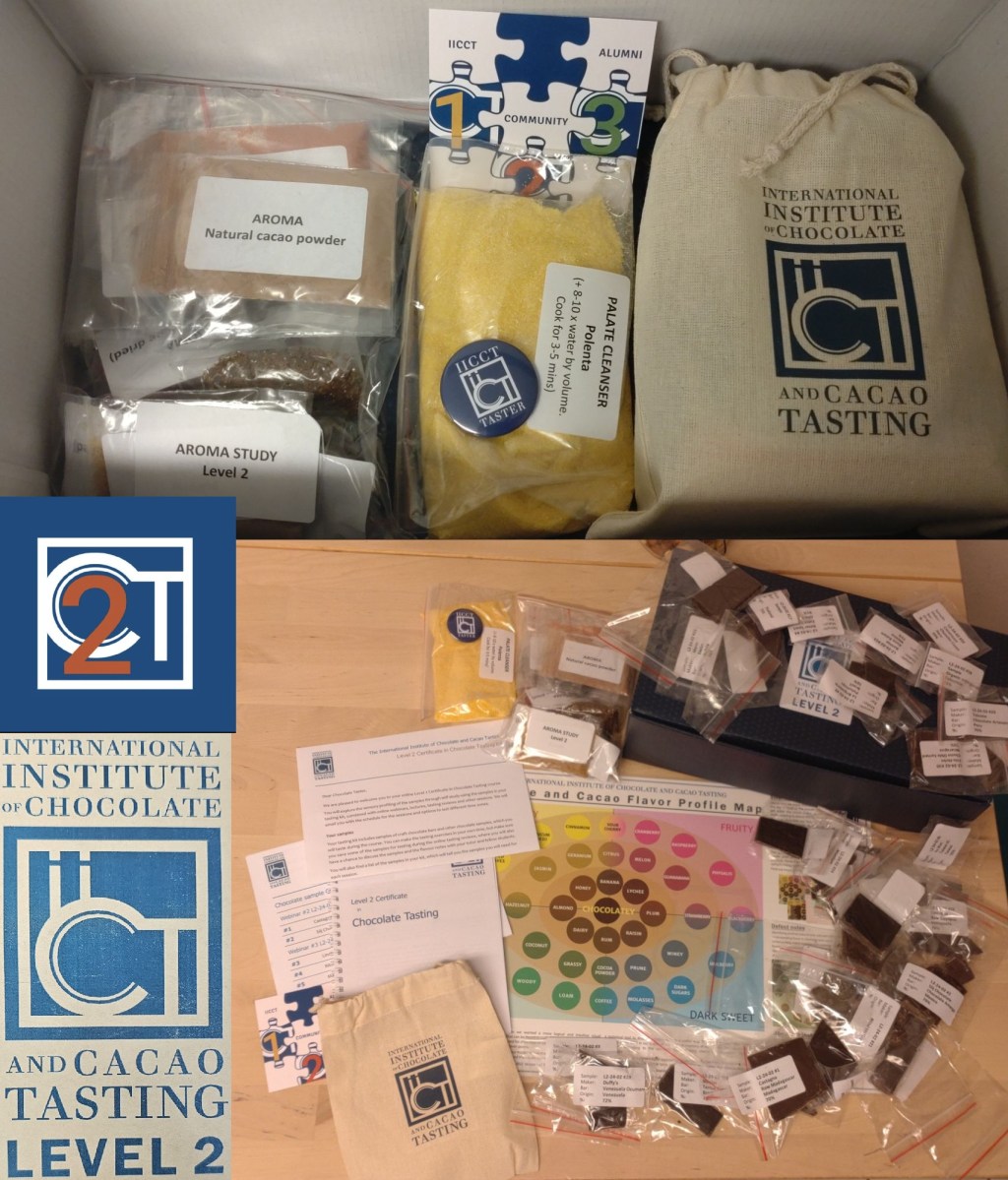
After the foundation of Level 1, this is where it deepens. Not a free fall, but a deep dive. With seven webinars, two dedicated sensory review sessions, two recorded lectures, home study, and a two-part exam at the end. These nine weeks were truly something next level, in so many ways. Based on my memories, impressions and notes (as it’s been some time), I’ll guide you through the process.
The tasting kit was the first clue that I outgrew the ‘newb level’ tasting. I received a proper flavour profile map which helped me to go and find my inner chocolate guide/judge and a full bag of 50-ish different chocolate samples. Most memorable: the defect samples…..
First webinar and the first sensory review were all about learning how to read and work with the Flavour Map. This is where you get handed the actual tool: the IICCT’s flavour profiling system: https://www.seventypercent.com/. A platform built based on research into aromatic compounds in roasted cocoa and food pairing science, modelled with a neural network trained specifically on chocolate tasting. I’ll promise to write about this specific paper in the Science of Chocolate.
Now on this platform, you score chocolate is a similar way speciality coffee does, then place up to ten flavour points on a map, in the order you actually taste them. Once you know how to read it, the map tells you almost everything. Cool feature is that it also shows what other tasters in the course picked out, showing if your flavour recognition overlaps or not. You can also go back and see if you pick the same things out every time. In other words: very cool tool.
The following three webinars we’ve had practice in our profiling skills. The online platform properly explained, experienced and, a set of practice chocolates to test it on. We also covered the cacao production scale. From the industrial tons and medium scale first, then micro batch chocolate production. I’ll admit my notes from these three webinars are thin, because I focussed a lot on the 70% platform. But what stuck with me is that scale doesn’t just change how much chocolate gets made, it changes the actual chocolate and which flavour decisions are even on the table to be made. The scale of the process influences the actual biochemical process.
Webinar 5 is the one that I will never forget, for more than one reason. First of all: I was alone, as in I was the only student there, with the instructor. The webinars are recorded, so you can review them, if you wish. But second of all; we tasted bad chocolates. And I have no words to describe some of the awful things I tasted. We all know the bitterness of most supermarket chocolates that can come from more than one error; over roasting, the variety itself, under fermentation. For those, I was prepared. But over fermentation swings the other way entirely, toward something cheesy, I still have the association with vomit. The way it smells was so clearly what I tasted. And then there’s a whole separate category that has nothing to do with fermentation or roasting at all: contamination, drying, storage, shipping. I could taste the smoke of the fire used to dry the beans and the asphalt it was spread on. Epic in many ways (I was impressed with my flavour recognitions), but horrific in others. Memorable for sure!
After that webinar, the next took a deep dive into different cacao varieties. Learning Amelonado is the type that took over West Africa, and its arrival there wiped out a lot of origin flavour that’s now more or less forgotten. White bean Criollo traces back to Central America and Venezuela, not Peru, which did surprised me. And the infamous CCN-51 came up again, this time with the full case against it: not fine flavoured in the slightest, but fast growing, disease resistant, big podded (so high yielding), and that’s exactly why it dominates the plantations of Ecuador, Peru and a good chunk of Colombia. Almost all cacao grown today is a hybrid, propagated by means of cloning, not via growing seedlings. Variety names are more like loose clusters than clean categories, and mislabelling is common. I’m sure experts reading my texts tell me I make mistakes. Good thing is that the science and technology we have today help us untangle some of this genetic soup.
A few things worth mentioning from my notes: the ICS series (Imperial College Selections) goes back to 1920s Trinidad and is still among the most widely grown cacao anywhere, especially in the Caribbean. ICS 95 might be the single most common one out there. Chuncho, on the other hand, is a cluster of around 117 different varieties, and a strong candidate for one of the oldest, most original cacao populations still growing.
The last webinar focused on fermentation quality and the general cacao market. I know the fermentation itself happens in two phases. A short anaerobic phase first, run by the yeasts already present on the beans, then the bacteria start to take over. Criollo needs noticeably less of this than other varieties. And what happens after fermentation depends entirely on where you are. Ecuador dries some cacao without fermenting it at all, Peru dries beans roadside, Papua New Guinea smoke dries theirs. Every choice leaves its own fingerprint on the flavour, and obviously, I name countries, but every farmer makes their own decisions in this fermentation process.
Robert Linxe of La Maison du Chocolat and Valrhona were given credit for pulling chocolate back to the track of origin based sourcing in France (a chocolatier tradition that works from the bean, not from ready made couverture). Though this is an ongoing battle…. Even now, there’s still surprisingly little solid knowledge about what a given origin is even supposed to taste like. And how could we cluster origens together when we can find differences between plantations and harvesting times? It’s one of the things that makes cacao so exiting! I don’t drink wine (don’t appreciate it) but I imagine the wine nerds talk the same language as the cacao and coffee nerds do!
After tasting over 50 different chocolates (good and bad), it was time for the exam. This time in two parts, both on the same day, with a short break in between. A knowledge based multiple choice of thirty five questions with an hour on the clock. And a (nerve wrecking) blind tasting exam… The tasting samples arrive by post ahead of time. I was intimidated on this one. We all recognise different flavours, based on those we come into contact with. Yes, you can train this, but to have to actually profile for the test… I made a rule: don’t re-taste a sample more than twice, no matter how much you want to. You’ll just confuse yourself. But I got it all down and passed! It was an amazing ride!
Now will I do level 3? That is a question I ask myself a couple of times a year. There are moments that I want to (but it is costly) and there are moments in which I believe I am not ready (though I can’t tell you why not). For now, I leave it open. Diving into books and papers written about chocolate and cacao, visiting chocolate festivals and events. I sometimes dream about growing my own cacaco, making my own chocolate. Who knows what else I will do.
 By Diënty
Leave a comment