
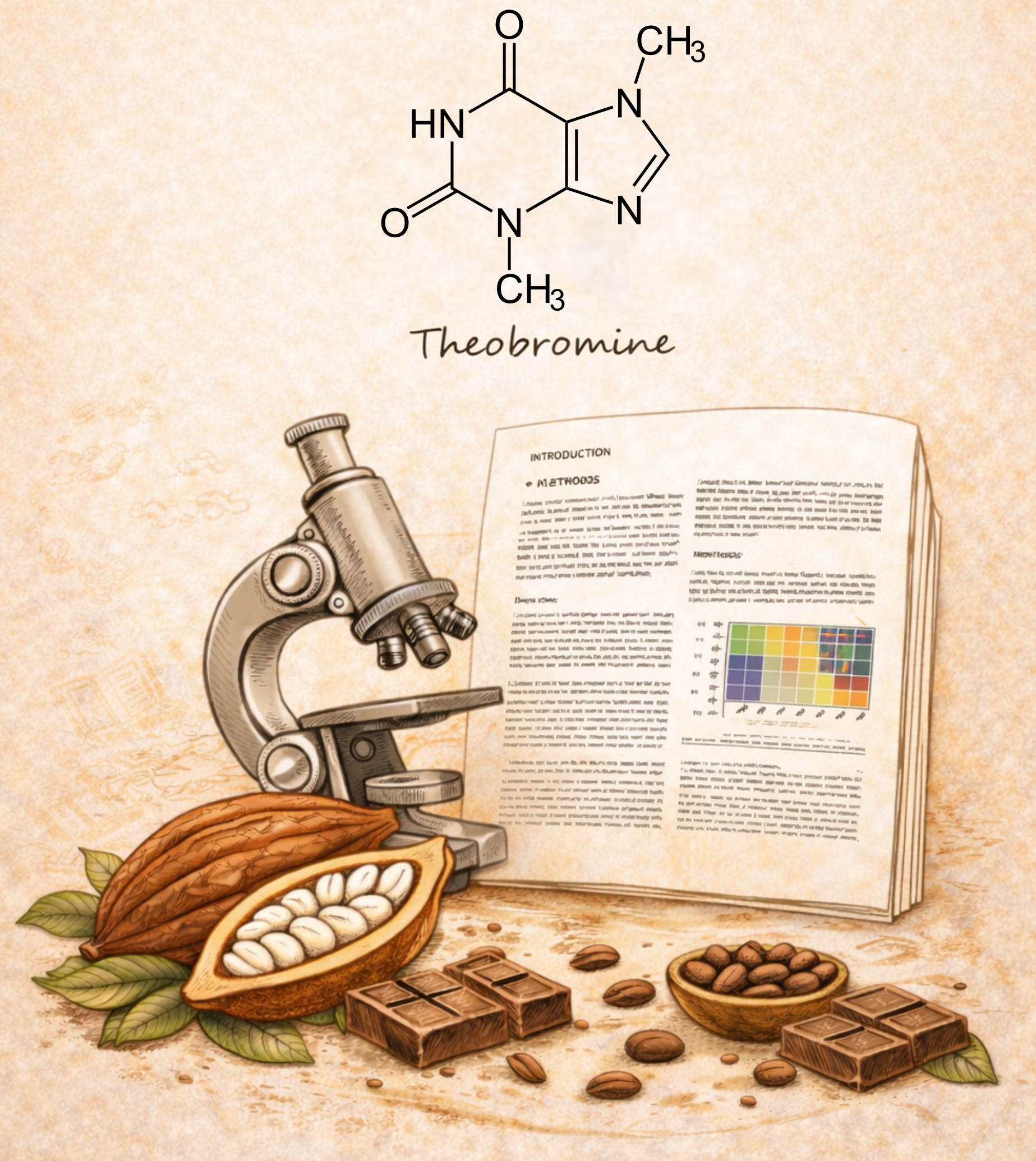
A closer look at the published genome assembly for CCN51. This is the single most widely planted cacao variety in Latin America, and one that comes with a genuinely mixed reputation. This paper is a resource paper rather than an idea driven experiment.
The authors built, and thoroughly validated, the highest-quality genetic map of this variety produced to publication date, rather than setting out to test one specific question. So this is more of a “what they built, and how they proved it’s reliable” story than a “what they did to prove something” one.
What a genome assembly actually is. (a little background first)
A genome assembly is essentially the equivalent of a finished jigsaw puzzle of an organisms entire DNA sequence. It is the pieced together order of DNA letters, collecting and fitting from millions of short, overlapping fragments, who are produced by a sequencing machine. Cacao, like most plants and animals, is diploid: it carries two copies of every chromosome, one inherited from each parent. In a hybrid variety like CCN51, bred from two genetically distinct parent trees, those two copies (called haplotypes) can differ from each other quite a bit. Older genome assemblies usually blended the two haplotypes into one averaged sequence. This is easier to build, but loses information about which specific version of each gene came from which parent and is on which of the genes. A “haplotype-resolved” assembly, like this one, keeps the two haplotypes separate all the way through, which is both harder to do and viewed considerably more useful.
The other key term in the official title of this paper is T2T, short for telomere-to-telomere. Telomeres are the protective caps at the very ends of a chromosome, and older genome assemblies almost always had gaps near those endings. A near-T2T assembly like this one manages to read a chromosome essentially from one end to the other with very few of those gaps left, which is exactly why the authors can meaningfully claim it’s the most complete cacao genome published to date.
What motivated the authors
CCN51 (short for Colección Castro Naranjal 51) was bred in Ecuador in the 1960s and released opon the world in 1984. It has since become the dominant hybrid across Latin America thanks to its high yield, broad disease resistance, and tolerance of difficult growing conditions. But it’s also widely regarded as “bulk” cacao: sensory panels describe it as strongly acidic, bitter and astringent. Its found lacking the floral, nutty and fruity notes prized in the fine-flavour varieties like Ecuador’s own Nacional.
Its very success has become a concern in its own right, since farmers switching to the CCN51 cacao for its reliability, risk squeezing out the traditional, genetically diverse fine-flavour varieties. Farmers and breeders have responded by using CCN51 as a parent to combine its productivity and toughness with better flavour from other varieties. Doing that kind of targeted breeding requires a detailed, reliable map of CCN51’s own genes to work from, which is now available.
What they did
The authors extracted DNA from CCN51 leaf tissue and sequenced it using PacBio HiFi long-read sequencing (a technology that uses very long reads (large jigsaw pieces), of highly accurate stretches of DNA in one go. These big chunks are well suited to resolve and find the repetitive regions that trip up older, shorter-read methods. Combined with “Dovetail Hi-C data”, a technique that captures information about how DNA is physically folded inside the cell. Dovetail uses that to help stitch large fragments together in the correct chromosome-scale order. From this data they assembled both haplotypes separately into full chromosome sets, then annotated the assembly.
Predicting where every protein-coding gene is located, using a combination of RNA evidence from cacao tissue, comparing it against five other previously sequenced cacao varieties, and using computational gene-prediction models. They also catalogued the genome’s transposable elements (TEs), the repetitive, self-copying stretches of DNA sometimes called “jumping genes” because they can insert new copies of themselves elsewhere in the genome. To check their work, they compared CCN51’s completeness and accuracy scores against six other published cacao genomes. Overall a computation heavy process.
What they found
The assembly reached 10 full-length chromosomes for each of the two haplotypes, plus the separate mitochondrial and chloroplast genomes. With the telomeres successfully identified at both ends of all 10 chromosomes, confirming the near-T2T claim. By two separate completeness measures, the authors reported this as the highest-quality cacao genome published to date, edging out the six previous reference genomes they compared it against. Some numbers: Gene annotation identified 22,941 and 22,948 protein encoding genes across the two haplotypes, with the vast majority successfully matched to known genes in existing databases. This is giving future researchers a reliable starting list of CCN51’s genes to search through.
Comparing CCN51’s gene families against the other cacao varieties turned up 147 gene families that have expanded and 358 that have contracted compared to CCN51 specifically. These differences are strong candidates for explaining some of CCN51’s distinctive traits, like its productivity and disease resistance, though pinning down exactly which expanded families do what is a job for future studies.
On the transposable element side, CCN51’s genome turned out to be 62.36% transposable elements by length, a notably higher proportion than previously reported for other cacao varieties, and the authors managed to classify 59% of them using a newer machine-learning tool, well beyond what earlier studies achieved.
Mapped across the chromosomes, genes were consistently denser near the chromosome ends, while transposable elements clustered more heavily around the centromeres. The structural midpoints of each chromosome, a pattern that’s fairly typical of plant genomes in general.
Summary
This isn’t a single discovery so much as a foundational resource: the most complete and well-annotated genetic map of CCN51 built so far. It is freely available for other researchers to use. Given how directly CCN51’s genetics affect Latin America’s cacao industry, both through its dominance on farms and through its growing role as a parent in breeding programmes trying to combine its toughness with better flavour, having this level of detail to work from should genuinely speed up any kind of targeted breeding.
Paper details
Full title: Near T2T haplotype-resolved genomes of cacao (Theobroma cacao) variety CCN51
Authors: Huawei Tan, Yaxin Lou, Yuchen Yan, Lyndel W. Meinhardt, Bryan Bailey, Osman Gutierrez, Sunchung Park, Stephen P. Cohen, Dapeng Zhang & Yanbin Yin
Journal: Scientific Data (2025). Accepted 15 December 2025, published online ahead of final formatting.
Official citation: Tan, H., Lou, Y., Yan, Y. et al. 2025. “Near T2T haplotype-resolved genomes of cacao (Theobroma cacao) variety CCN51.” Sci. Data (2025).
Link to full article: https://doi.org/10.1038/s41597-025-06480-w
Leave a Reply