
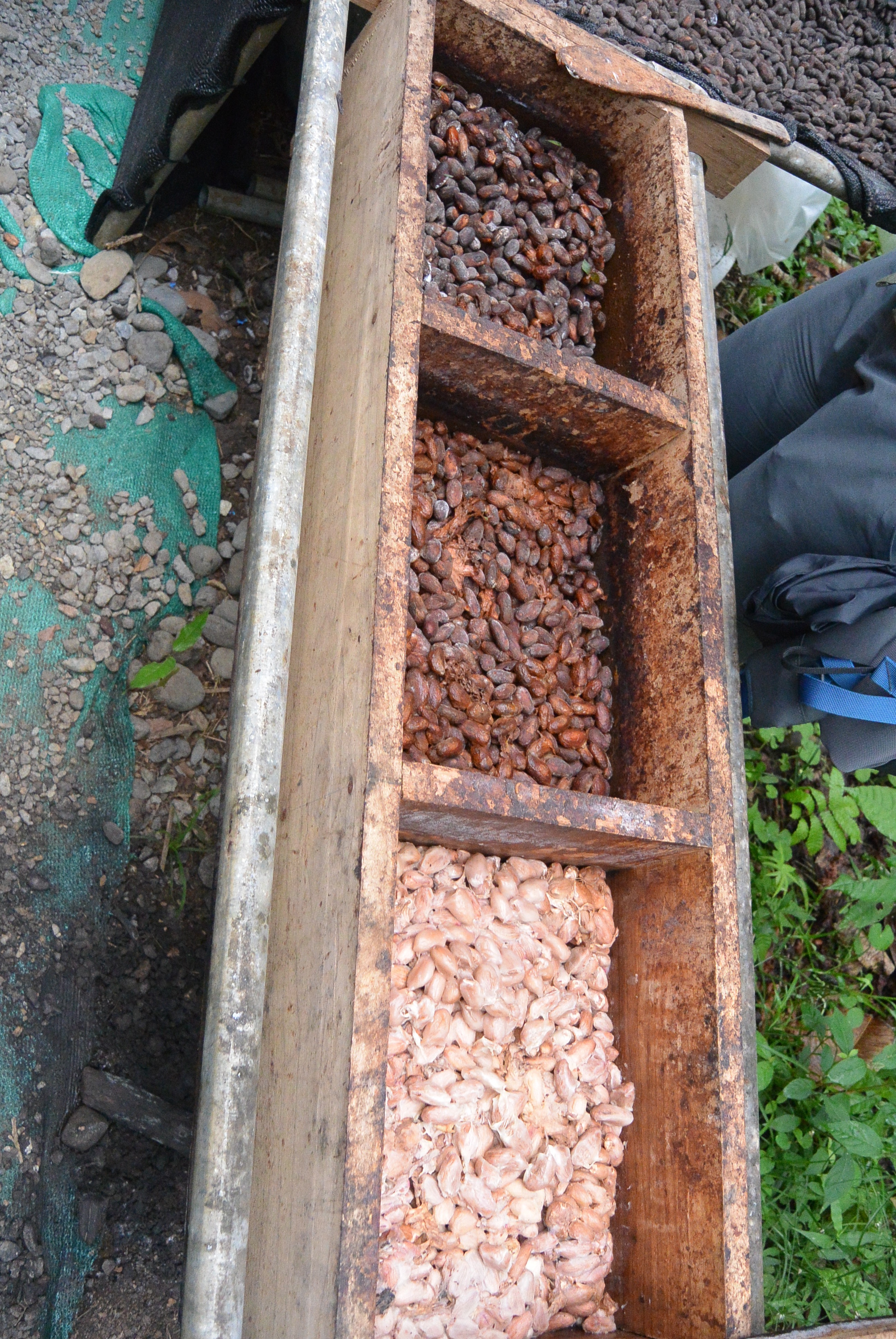
Fermentation is where chocolate flavour actually begins to exist as something we can influence. Don’t get me wrong, the tree, location, farmer, genetics, they all matter!What I mean to emphasise is that with fermentation we can influence the process more targeted. Whyis it this step and not roasting, or drying? Because this is where the raw material (the beans) stops being just a seed and starts becoming something you would actually want to eat (eventually).
Time to open up
The pods that were harvested, the moment they open up, that is where the fermentation story starts. The moment the beans, covered in sugary pulp and dripping with it’s juice get exposed to air.
Into the box, the basket, or the heap
The wet beans, can be squeezed first, to remove excessive juice. The beans, still coated in that sugary pulp, get piled up somewhere warm. Exactly where depends on where you are. From farm to farm, fermentation station to fermentation station, there csn be different processing techniques used. The following does generalise a lot, but lets say the following can be found: in West Africa, they pile the beans up in heaps under banana leaves, or simple baskets. In Latin America, and on plenty of smaller, quality focused farms, wooden boxes do the job instead. Sometimes a whole set of them, so the beans can be shifted from one box to the next as fermentation goes on. Some are experimenting with local split fermentation, not something I discuss here. Whatever the container, the goal doesn’t change. Trap the heat, keep enough air moving, and let the microbes already living on the beans and in the air get to work.
The pulp is doing more than you would think
That sugary coating around each bean, the pulp or mucilage, is mostly water, sugar and acid: sucrose, glucose, fructose, sitting there as fuel, readytobeconverted. Without it, none of what follows would have anything to run on. There would not be any fuel for the fermentation, so to speak.
As the fermentation process progresses, enzymes break that pulp down until it turned entierly liquid and drains away. Farmers call this runoff sweatings. The fluid carries citric acid out with it as it goes, one of the reasons the whole mass gradually becomes less acidic as the days pass, not more.
Two phases, one wild handover
For the first day or two, oxygen barely reaches the middle of the pile. Wild yeasts take advantage of that, and start eating the sugars in the pulp, producing alcohol and carbon dioxide as they go. It smells exactly like you would expect: sweet, boozy, faintly like a bakery.
Then enough of the pulp has reduced to allow air to get in, which changes the whole microbial cast. Bacteria take over: first ones that produce lactic acid, then acetic acid bacteria, which turn that alcohol into something close to vinegar. This second step is fiercely exothermic. Temperatures inside the mass climb from room temperature to somewhere around 45 to 50 ℃ from the reaction itself.
Left alone, that heat would simply build in one spot while the rest of the pile stayed cooler and less developed, leading tununeven fermented beans. So to prevent this, the beans get turned: moved and mixed by hand or shovel, roughly once a day in plenty of traditional set ups. Turning lets fresh oxygen reach the bacteria that need it, and spreads the heat more evenly. Overdo it, though, and you can knock the whole process off balance rather than help it. There is such a thing as trying too hard in this gentle process.
There are many differences and nuances I’m not highlighting here. Saving that for more detailed pieces I have yet to write (stay tuned). Criollo beans need noticeably less time in all of this than most other varieties. Two or three days can be enough. Bulkier, hardier varieties often need five to seven.
Bleak point: the beans have to die for any of this to matter
Heat and acid together do something that sounds almost brutal: they kill the seed. The embryo part inside the seed stops being a living thing that could one day grow into a tree. Once killed, the cell walls inside the bean breaks down. Making that enzymes that were previously locked away suddenly have access to everything else in there: sugars, proteins, the bitter compounds called polyphenols. They start rearranging all of it into the flavour precursors that roasting will later turn into actual chocolate taste. Skip this step, or rush it, and there is nothing for the roaster to work with later.
The bitterness drops dramatically in the process, by around 85% as those polyphenols get broken down. The beans themselves change colour too, from a pale white or purple (depending on the variety) to a deep brown by the end.
Getting it wrong in either direction
Stop too early, and the beans stay stubbornly purple, without the fine cracks that properly fermented beans develop inside. Cut one open and it still tastes sharply bitter and astringent, closer to raw cacao than chocolate. Go too far the other way, past about seven days, and different problems appear, like fungal or cheese like off notes. Acetic acid climbing higher than it should, which then means a much longer conching stage later just to soften it back out. Fermentation has a proper window, not an endless one where more is automatically better.
What your nose would tell you
If you have the chance (like I did) to stick your nose close to a fermenting heap on day one, you would get something sweet and slightly vegetal. By day two or three: boozy, yeasty. By the final day: sharp, sour, properly vinegary. All of that in one week, and all from the same pile of beans.
So by the end of fermentation, the beans are hot, wet, smell strongly of vinegar, and are entirely unrecognisable from where they started. They are also, somewhat surprisingly, still not ready to become chocolate. Drying comes next, and that is a story for another post.
Leave a Reply