
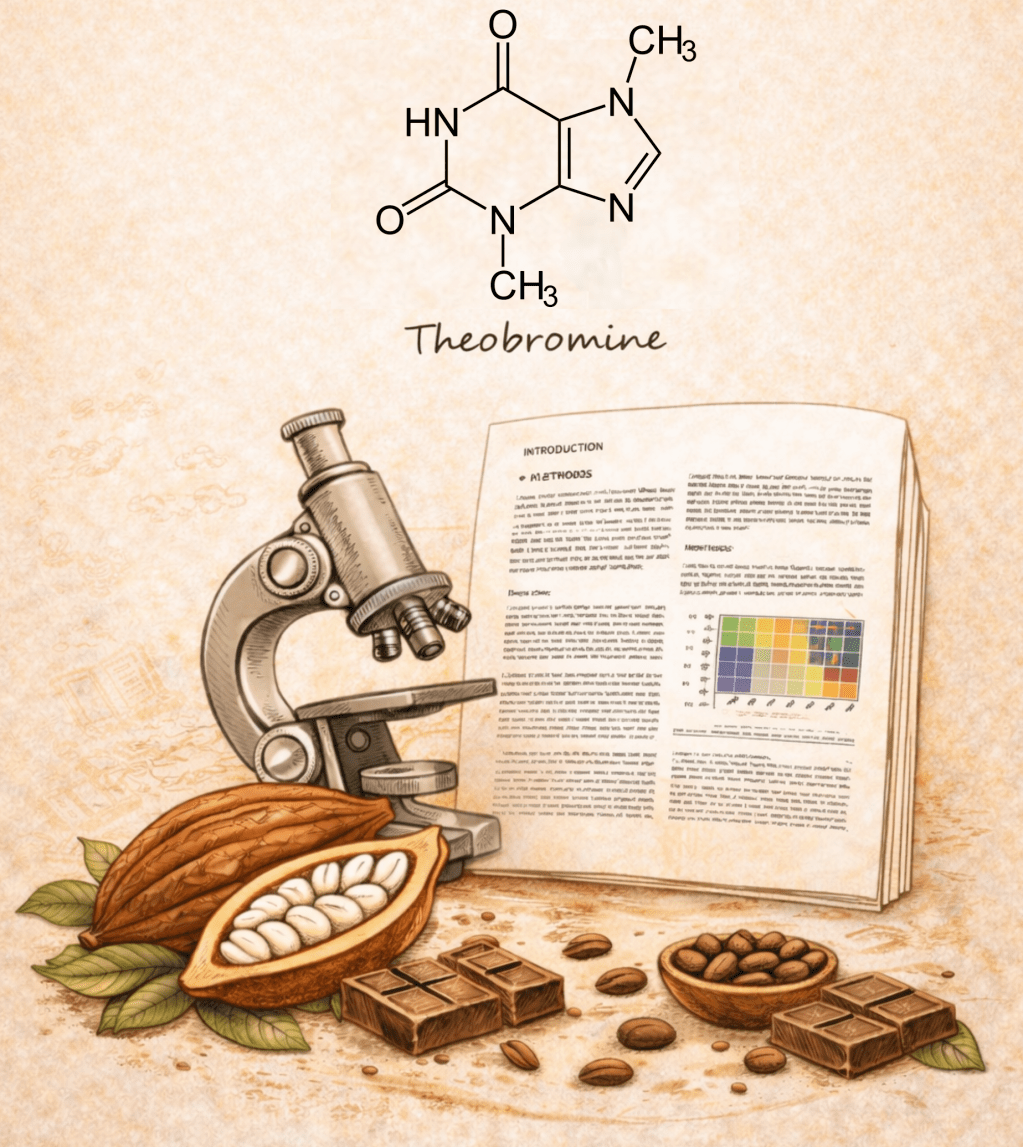
A review of Cacao Swollen Shoot Viruses in Ghana, using decades of colonial field reports combined with several modern genetic studies. Ghana has been one of the world’s top cocoa producers for over a century, but for nearly as long it’s also been fighting the very first cacao-infecting virus ever discovered: cacao swollen shoot virus (CSSV). It consists of not one virus, but a complex of different Badnavirus species. It is spread by small insects called mealybugs.
As I mentioned, this paper is a review article. That means that it is not a single study. I think a review is best described as a summary of several scientific findings. This can cross different technologies and fields of study.
What is Swollen Shoot Virus (a little bit of background first)
Before we get started on the review, I’d like to explain a bit about the issue at hand.
Cacao swollen shoot disease is caused by a virus cacao swollen shoot virus (CSSV). It’s not a single virus, but actually a group of related viruses (badnaviruses) that cause the infection. With at least six species known and many regional strains (varieties) found. It’s spread mainly by small sap-feeding insects called mealybugs. The spread occurs when a mealybug feeds on an infected tree and then moves to a healthy tree, carrying the virus along.
Infected trees develop red or yellow vein banding on their leaves. Their leaves start curling, and characteristic swellings appear on the tree’s stems and roots (hence the name). Depending on the virus strain, symptoms range from mild or barely noticeable to so severe that it can kill a tree within a few years.
It’s a serious problem for several reasons: it can wipe out cacao farms that take years to build and establish, and are meant to support a farming family for decades. Because there’s no cure once a tree is infected, the main control method has historically been cutting out infected trees before the virus spreads further. I can’t imagine the impact, both mentally and financially, as this means that a farmer has to destroy their own trees! Because different strains can co-infect the same tree and recombine into new variants of the virus, the virus keeps on evolving, making it a continues threat that is impossible to beat. An onging threat to the livelihood of farmers in Ghana today, and chocolate enthusiasts around the world.
What motivated the authors
Cacao swollen shoot virus was first identified in the Gold Coast (now Ghana) in the 1930s and remains one of the biggest threats to the country’s cocoa industry today. Knowledge about it, its history, its many strains, how it spreads, and decades of attempts to control it, has been scattered. Written down in old colonial agricultural reports, that could be found all across the country. There has also been molecular research done, and the writers of this review have pulled all of that information together into one picture. Starting from the first symptomatic tree in 1936, to what modern genetic sequencing tells us about the virus today.
What they did
Rather than performing a single experiment, the authors collected and examined decades of material: original Gold Coast Department of Agriculture field reports from the 1930s to 50s, and later genetic and molecular characterisation studies that classified the virus’s many strains, together with mealybug (the insect that spreads it) biology studies, and available field trial data on what disease control methods have been tried and implemented. They have been building a full timeline from the virus’s discovery, up to today’s understanding of the virus. A bit like a ”swollen shoot biography’.
What they found
A farmer near Effiduasi first reported swollen, deformed shoots on his cacao trees in 1936. By 1940 researchers had confirmed the cause was a virus, the first one ever found infecting cacao. We now know CSSV is actually a group of related viruses (badnaviruses), ranging from mild and symptomless to highly virulent strains that can kill a tree within a few years through leaf yellowing, vein banding, and swollen stems and roots.
The virus is spread almost entirely by mealybugs, which are small sap feeding insects that hide in bark crevices. They are protected against their natural enemies and farmed by ants for their sugary secretions. It is a mutually beneficial relationship that incidentally protects the mealybugs from anything that would harm them, adding to the spread of the bugs. Making things harder still, trees are often infected with several virus strains at once, and the authors note that coinfecting strains can swap genetic material amongst themselves and recombine into new variants.
CSSV isn’t one virus but a whole family of related ones, classified under the genus Badnavirus. Each strain carries a small, circular, double-stranded DNA genome packaged inside a rod-shaped particle. That genome is organised into several “open reading frames” (ORFs), essentially genetic instruction blocks, encoding everything the virus needs to hijack a plant cell. Researchers classify CSSV strains into different species and groups based on how many of these ORFs a strain carries, and on how similar particular sequence parts are to other strains. So strains sharing at least 80% sequence identity in that region are grouped as the same species. This genetic fingerprinting is also how scientists caught the virus mid-evolution: when two or more strains infect the same tree, they can swap segments of their DNA during replication, and genetic analysis has already turned up at least six such recombination events among Ghanaian CSSV strains, with the swapped regions clustering in a couple of predictable spots in the genome. Despite being discovered nearly a century ago, CSSV’s genetic diversity is still being actively mapped and, evidently, still actively changing.
Since the 1940s, the main defence has been “roguing”: cutting out infected trees, and often the healthy-looking ones around them too, before the virus can spread further. It’s brutally effective at slowing outbreaks, but it means destroying farmers’ own long-term livelihoods. That’s where the story turns political: when Britain’s colonial government made tree removal compulsory, paying only minimal compensation, it triggered serious rural anger. That resentment fed directly into the growing anti-colonial movement of the 1940s, and the authors argue it became one of the pressures that helped propel Kwame Nkrumah’s independence movement as Ghana became independent from Britain in 1957. Roguing, alongside newer resistant cacao varieties, is still the primary control method in use today.
Summary
Cacao swollen shoot virus isn’t just a plant disease story. It is an active threat, woven into Ghana’s cocoa and political history. With co-infecting strains recombining into new variants of the virus, the authors call for renewed investment in African plant virology research to keep pace with the threat. A call that I echo strongly, as I too fear that without a better understanding of the virus, and expanding research as to how farmers can protect their crops, the future of cacao in Ghana is not only in peril, but there is a potential that cacao farmers across the globe are forced to turn to an alternative crop in a desperate attempt to provide for themselves and their families.
Paper details
Full title: Cacao Swollen Shoot Viruses in Ghana.
Authors: Ebenezer Antwi Gyamera, Owusu Domfeh & George Akumfi Ameyaw
Journal: Plant Disease, Volume 107, No. 5 (May 2023), pages 1261–1278. Accepted for publication 7 December 2022.
Official citation: Gyamera, E.A., Domfeh, O., and Ameyaw, G.A. 2023. “Cacao Swollen Shoot Viruses in Ghana.” Plant Disease 107(5): 1261–1278.
Link to full article: https://apsjournals.apsnet.org/doi/10.1094/PDIS-10-22-2412-FE
 By Diënty
Leave a comment