
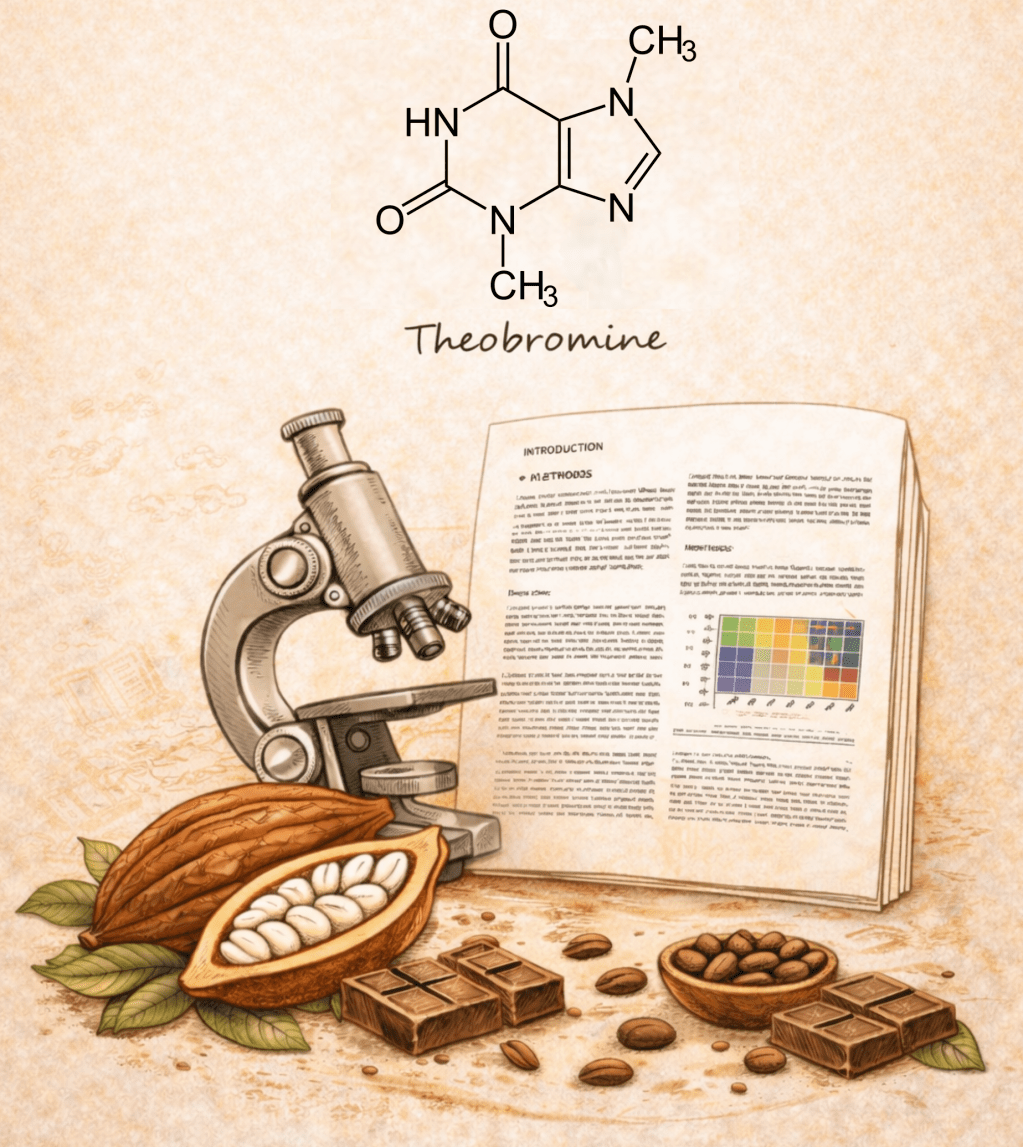
Time for a look at the Cacao Gene Atlas. This is a public database locating which of Theobroma cacao’s genes are switched on across 123 different tissues and life stages. This atlas was built from 390 individual samples.
Breeding a new cacao variety, for example one that’s higher in yielding, or more resistant to a disease (like the swollen shoot virus I wrote about earlier), takes an estimated 20 to 30 years. Part of the reason this is so slow a process is that (until now), breeders had very little detailed information about which of cacao’s genes actually do what, and when and where in the plant they’re switched on. Have I lost you already? Let me explain.
This paper is what we call a resource paper: the researchers built and thoroughly validated a huge public database of gene activity, rather than setting out to test one specific question. So instead of a “what they did to prove X” story, this is more of a “what they built, and how they proved it actually works” story.
What is a gene atlas anyway (a little background first)
Before diving in, it helps to know what’s actually being measured here. Every cell in a plant carries the exact same set of genes, but not every gene is switched on in every cell, all the time. A gene being “switched on” (or as biologists call it; expressed) means the cell is actively copying that gene’s instructions into RNA. And building RNA is what is needed for a cell to build a protein. It’s the same principle as following a cooking recipe to prepare a nice cake. So by measuring which genes are producing RNA in a given tissue, and how much of it, you can tell which genes are actually doing something, and what that something is. If you do this across enough tissues, you get an atlas: a map of which genes are active where, and when. Kind of like a cookbook, but with specific ingredients to match the conditions. Cacao has never had one of these built at scale before, and that’s exactly the gap this paper fills.
What motivated the authors
For most other major crops of the world, there already have been rich, searchable gene expression atlases that researchers can use to quickly narrow down candidate genes for traits like yield or disease resistance. Cacao never had one at this scale, so the authors set out to build exactly that: an open resource, available to everyone, mapping gene activity across cacao’s entire life cycle. So that any cacao researcher (or curious blogger) can search these genes for free.
What they did
All of this computer work needs real cacao input. So the authors extracted and sequenced (a form of DNA and RNA reading) RNA from 123 different cacao tissues, during different developmental stages. They collected between 3 to 5 repeats of each, each so the results would hold up statistically. After all, repetitive outcomes tend to reveal the truthful situation. Together these 390 transcriptomes (a transcriptome being, essentially, a full snapshot of which genes are active in a sample) in total. This covered:
- A full developmental atlas, from seedlings all the way through to the flowers, fruit and seeds, across three cacao varieties (a Scavina, a Criollo and CCN-51).
- A drought and day/night (diurnal) time course, tracking how gene activity shifts over 24 hours and under water stress
- A disease atlas, tracking gene activity in leaves after infection with Phytophthora megakarya, a major cacao pathogen, comparing resistant and susceptible varieties
All of this was built into a free, searchable online browser, where you can look up a single gene and see a colour-coded map of exactly where and when it’s active in the plant. To make sure the atlas was actually trustworthy, the authors tested it against six genes whose behaviour is already well understood in Arabidopsis, a much more thoroughly studied research plant, to see whether cacao’s equivalent genes showed matching patterns.
What they found
Next to building the atlas, the researchers also looked at some of the things they identified and they found that four of the six validation genes behaved exactly as predicted. A general “housekeeping” gene (one that keeps basic cell functions running) was active everywhere, as expected, while a seed-maturation gene stayed essentially silent throughout the plant and switched on strongly only in maturing seeds, matching its known role in helping seeds survive drying out.
Two genes, though, didn’t match their Arabidopsis counterparts at all. One of them, a water-channel gene normally tied to flowers in Arabidopsis, instead showed its strongest activity in cacao’s roots and fruit. That’s a sign the gene may have evolved a new, cacao-specific job over time. The same gene, inherited from a shared ancestor, quietly repurposed for something completely different, depending on which plant it ended up in. This process is what we call evolution.
Zooming out to the bigger picture: roughly half of all of cacao’s genes were detectably active in an average tissue type, with roots, growing shoot tips and young side-shoots showing the broadest activity. Open flowers stood out for having the largest set of genes switched on almost exclusively there, followed closely by immature embryos and young leaves. The drought and diurnal data captured genes responding on a very human timescale too: one stress-response gene ramping up hours into a drought, another rising and falling with the plant’s daily rhythm, like clockwork. The disease response data from Phytophthora-infected leaves sits in the same open resource, giving breeders a starting point for spotting genes involved in resistance.
Summary
This study isn’t a single discovery, so much as a new tool, genuinely useful: a searchable map of when and where about half of cacao’s genes switch on, across tissues, drought stress, day and night cycles, and disease infection. The Cacao eFP Browser system can be accessed free of charge.
Given how painfully slow cacao breeding normally is, having a shortcut to candidate genes for traits like disease resistance or yield could meaningfully speed up the development of better varieties.
Paper details
Full title: The cacao gene atlas: a transcriptome developmental atlas reveals highly tissue-specific and dynamically-regulated gene networks in Theobroma cacao L
Authors: Evelyn Kulesza, Patrick Thomas, Sarah F. Prewitt, Akiva Shalit-Kaneh, Eric Wafula, Benjamin Knollenberg, Noah Winters, Eddi Esteban, Asher Pasha, Nicholas Provart, Craig Praul, Lena Landherr, Claude dePamphilis, Siela N. Maximova & Mark J. Guiltinan
Journal: BMC Plant Biology, Volume 24, Article 601 (2024)
Official citation: Kulesza, E., Thomas, P., Prewitt, S.F. et al. “The cacao gene atlas: a transcriptome developmental atlas reveals highly tissue-specific and dynamically-regulated gene networks in Theobroma cacao L.” BMC Plant Biol 24, 601 (2024).
Link to full article: https://doi.org/10.1186/s12870-024-05171-9
 By Diënty
Leave a comment